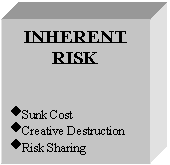
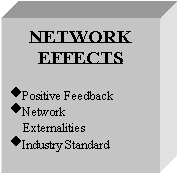
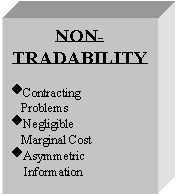
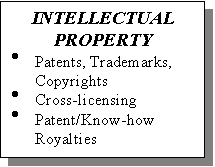
INTANGIBLES: Management, Measurement, and
Reporting. 1
Executive
Summary. 4
Part I: What, Why, and Who. 9
Ask: What are
intangible assets? Why the current heightened interest in these assets? Who
should be concerned about intangibles:
I.1 What are Intangible Assets?. 10
I.2 Intangibles: Why Now?. 13
Fundamental
Changes Driving Intangibles. 15
Ford
Remaking Itself Into a Cisco. 16
Intangible
Linkages and Human Resources. 19
The
Urgency to Innovate. 21
I.3 So What? Who Should Care About
Intangibles. 26
I.4 Takeaway Points. 29
References. 30
Part II: The Economics of Intangibles. 31
Presents the unique attributes of
intangible assets that distinguish them from physical and financial assets, and
outlines an economic framework to analyze issues relating to intangibles.
Introduction. 32
II.1
Nonrivalry (Nonscarcity)—Scalability. 33
II.2
Network Effects. 38
II.3 If
It’s So Good…?. 44
II.4
Partial Excludability and Spillovers. 47
II. 5 The
Inherent Risk of Intangibles. 53
II.6
Markets in Intangibles. 58
Are Intangibles Inherently
Non-Marketable?. 59
What Does History Tell Us?. 62
II.7 The
Cost–Benefit Tension. 65
Part III: The Record. 68
Analyzes the record of intangible
investments, that is, the empirical findings concerning the nature of
intangible assets, and their impact on the operations and growth of business
enterprises, as well as on investors in capital markets..
III.1 The Value Created By Intangibles: A
case study. 70
The
Contribution of Chemical R&D.. 70
III.2 R&D and the Growth of Business
Enterprises. 75
Market
Value and Patents. 77
The
Patents Research. 79
III.3 Organizational Capital 84
Computer-Related
Organizational Capital 85
III.4 Brands, Franchises, and
Customer-Related Capital 89
Customer
Acquisition Costs. 89
The
Acquisition of Internet Customers. 91
Customer-related
Output Measures. 93
Internet
Traffic Measures. 95
III.5 And, What About Human Resources?. 97
What
are Human Resource Intangibles?. 97
Some
Research Findings. 99
III.6 Takeaway Thoughts. 102
Part IV: Intangibles in the Dark. 104
Outlines the reasons, both economic
and political, for the current deficient disclosure of information about
intangibles, and surveys the empirical record concerning the private and social
harms of the information deficiencies.
IV.1 The Tangibles–Intangibles Accounting
Asymmetry. 108
IV.2 The Politics of Intangibles. 113
The
Information Revelation Principle. 113
IV.3 Intangibles Darkly: The Consequences. 120
The
Current Disclosure Environment 120
The
Consequences of Information Asymmetry. 122
IV.4 Evidence of Harms. 127
High
Cost of Capital 127
Systematic
Undervaluation of Intangibles. 128
A
Level Playing Field?. 129
The
Deteriorating Usefulness of Financial Reports. 131
Manipulation
Through Intangibles. 133
IV.5 Takeaway Thoughts. 135
Part V: What Then Must We Do?. 137
Lays the foundation for a
comprehensive, coherent information system, reflecting investment conseuences
and value of intangibles, for use both internally and externally of
organizations.
V.1 The Objectives of the Proposed System.. 139
V.2 The Fundamentals of the Proposed
Information System.. 143
And
What About Accounting?. 147
V.5 The Scoreboard. 150
A
Parsimonious Scoreboard?. 157
V.6 Eliciting Disclosure. 159
The
Dual Role of Accounting Policy. 160
Standardizing
Information on Intangibles. 161
V.7 Takeaway Thoughts. 163
Wealth and growth in today’s economy are primarily driven
by intangible (intellectual) assets. Physical and financial assets are rapidly
becoming commodities, yielding an average return on investment. Abnormal
profits, dominant competitive positions, and sometimes even temporary
monopolies are achieved by the sound deployment of intangibles, along with
other types of assets.
It is,
therefore, hardly surprising that in recent years intangibles have captured an
increasing niche in the mushrooming management literature, both popular and
academic.
Central among the issues discussed is the information deficiencies due to the
shortcomings of the traditional accounting system to reflect value and
performance of intangible assets. Calls for improved disclosure of information
about intangibles often follow the discussion of deficiencies.
This
report advances the intangible (intellectual, knowledge) assets literature in
four key dimensions:
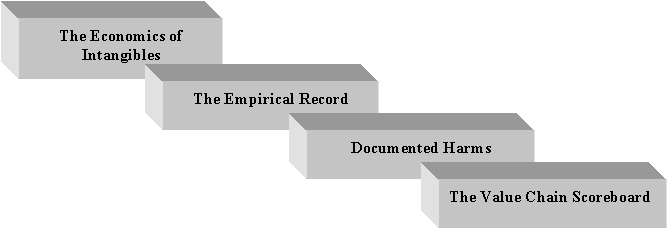
I open this report on intangibles by addressing in Part I
the three Ws: what are intangible assets, why the
current interest in them, and who should be concerned about
intangibles? I trace the meteoric rise over the past two decades in the value
and impact of intangibles to fundamental changes in the structure and scope of
business enterprises. Specifically, relentless competitive pressure induced by
the globalization of trade, far-reaching deregulation, and technological
changes (most recently the Internet) forced companies to increasingly rely on continuous
innovation (of both products and organizational designs) for survival and
growth. Innovation in turn, is primarily achieved by investment in intangibles
assets (research and development (R&D), information technology (IT),
employee training, customer acquisition, etc.)—hence the steep rise in the role
of these assets in the production functions of businesses.
What are
the economic laws governing intangible assets? I address this fundamental
question in Part II of the report: The Economics of Intangibles. Much of
the management literature extols the upside of intangibles, primarily
their ability to create value by scalability and network effects. Often missing
from the discussion is the counterweight: the challenges of managing
intangibles and achieving scalability and network externalities. Accordingly, I
develop an economic framework for analyzing issues concerning intangibles,
which encompasses both value drivers and value detractors: scalability
(nonrivalry), increasing returns, and network effects vs. partial excludability
(the general lack of full control over the benefits of intangibles), inherent
risk, and non-tradeability (absence of organized markets in intangibles). I
then demonstrate how this economic framework for intangibles—a cost–benefit
analysis—facilitates and enriches the discussion of managerial, investment, and
policy issues concerning intangible (intellectual) assets.
Research
on various issues concerning intangible (knowledge) assets, both conceptual and
empirical, is quite extensive; yet it is scattered in the economics,
organization, strategy, finance, and accounting journals. In Part III of the
report, I survey and synthesize much of this research, focusing on the
contribution of intangibles to corporate value and growth. This record taking
encompasses the three major nexuses of intangibles: discovery (e.g., R&D),
organizational capital (e.g., brands), and human resources. The dominant theme
of the surveyed research is the establishment of empirical linkages between inputs
(e.g., investment in R&D, IT, customer acquisition) and outputs
(earnings, productivity, shareholder value). Accordingly, Part III can be
viewed as bringing the evidence to bear on the economics of intangibles that is
discussed in Part II.
Information,
or the lack thereof, centrally impacts intangibles. Superficially, the
information deficiencies are the result of accounting shortcomings (e.g.,
expenditures on intangibles are expensed, while those on physical and financial
assets are capitalized). In fact, the “information failures” concerning
intangibles are deeply rooted in their economic attributes (the economics of
intangibles). Prescriptions for improvement in the information available about
intangibles are obviously predicated on an understanding of those root causes,
as well as on an appreciation of the current motives and incentives of the
information providers—managers and auditors.
In Part IV
of the report, I thus trace intangibles’ measurement and reporting problems to
the unique attributes of these assets—high risk, lack of full control over
benefits, and absence of markets. I then show how this analysis, focusing on
root causes, can be used to shape proposals for improved information
disclosure. Relatedly, I discuss the “politics of intangibles’ disclosure,”
that is, the fact that corporate executives and auditors currently have few, if
any, incentives to expand the information available about intangibles. This
rarely discussed incentives issue presents a major stumbling block for any
improvement in the information environment surrounding intangibles.
All this
would have mattered little if the information deficiencies concerning
intangibles were not causing serious private and social harms. Accordingly, the
major share of Part IV of the report is devoted to a theoretical and empirical
analysis of the harms (damages) associated with deficiencies in intangibles’
disclosure. I show that economic theory predicts—and empirical evidence
confirms—that deficiencies in intangibles’ disclosures are associated with the
following:
(a) Excessively high cost of capital, particularly for
enterprises in dire need of financing, namely early-stage knowledge-intensive
companies.
(b) Systematic undervaluation by investors of the shares of
intangibles-intensive enterprises, particularly those that have not yet reached
significant profitability. Undervaluation hinders investment and growth.
(c) Excessive gains to officers of R&D-intensive companies
from trading in the stocks of their employers (insider gains). Such gains come
at the expense of outside investors and may erode confidence in the integrity
of the market.
(d) Continuous deterioration in the usefulness of financial
information, possibly leading to volatility and excessive riskiness of
securities.
(e) Manipulation of financial information through intangibles.
The documented harms are indeed serious.
Finally,
the Tolstoyan question: What then should we do? The concluding Part V of the
report advances a coherent information system encompassing the core of modern
business enterprises, which is the value (innovation) chain. I thus return to
the main theme of this report: the role of intangible investments, along with
other forms of capital, in firms’ innovations—the lifeline of the modern
corporation. The proposed information system is comprehensive, covering the
major phases of the value chain—discovery, implementation and
commercialization—and enumerates quantifiable, linked-to-value indicators for
each aspect of the value chain.
The literature and commentary on
intangible assets has reached a certain level of maturity. Several key issues
beg taking stock: the accumulated knowledge about intangible (intellectual)
assets, with particular emphasis on the economic laws governing intangibles;
the lessons to be drawn from the extensive research on intangibles; the private
and social harms related to information deficiencies concerning intangibles;
and ways to overcome these deficiencies. This report on intangible assets
provides such a stock taking.
It is appropriate at the outset of
this report to address the three W’s:
¨
What are intangible assets?
¨
Why the current interest in these assets?
¨
Who should care about intangibles?
Webster’s
International Dictionary defines intangible as: “Not tangible; incapable
of being touched or perceived by touch; impalpable; imperceptible.” For the
purpose of this report, which deals mainly with the economic attributes
and consequences of intangibles, we should narrow the scope of intangibles to intangible
assets.
An asset is
a claim to future benefits, such as the rents generated by commercial
property, interest payments derived from a bond, or cash flows from a
production facility. An intangible asset is a claim to future benefits that
does not have a physical or financial (a stock or a bond) embodiment. A patent,
a brand, or a unique organizational structure (e.g., an Internet-based supply
chain) that generates cost savings, are intangible assets.
Throughout this report, I will use the terms intangibles,
knowledge assets, and intellectual capital interchangeably. All three are
widely used—intangibles in the accounting literature, knowledge assets by
economists, and intellectual capital in the management and legal literature—but
they refer essentially to the same thing: a non-physical claim to future
benefits. When the claim is legally secured (protected), such as in the case of
patents, trademarks, or copyrights, the asset is generally referred to as
intellectual property.
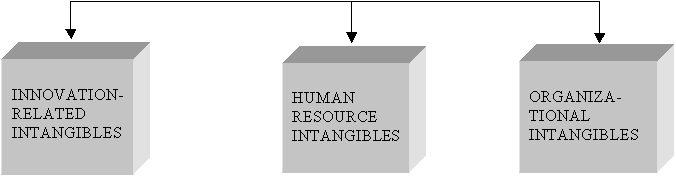
There are
three major nexuses of intangibles, distinguished by their relation to the generator
of the assets: innovation, organizational practices, and human resources. The
bulk of Merck & Co.’s intangibles were obviously created by Merck’s massive
and highly successful innovation (R&D) effort (nearly $2B/yr), conducted
internally and in collaboration with other entities.
In contrast, Dell’s major value drivers are related to the second nexus, a
unique organizational design, implemented through direct customer marketing of
built-to-order (BTO) computers, via telephone and the Internet. Cisco’s
Internet-based product installation and maintenance system, which generates
$1.5B/yr in savings, is another example of an intangible created by a unique
organizational design.
Brands, a
major form of intangible prevalent particularly in consumer
products—electronics (Sony), food and beverages (Coca-Cola), and more recently
in Internet companies (AOL, Yahoo!, and Amazon)—are often created by a
combination of innovation and organizational structure. Coke’s highly valuable
brand is the result of a secret formula and exceptional marketing savvy. The
unique products created and acquired by AOL during the 1990s are responsible
for its brand, along with massive marketing (customer acquisition) costs.
The third
nexus of intangibles, those related to human resources, are generally created
by unique personnel and compensation policies, such as investment in training,
incentive-based compensation, and collaborations with universities and research
centers. Such human resource practices enable employers to reduce employee
turnover, provide positive incentives to the workforce, and facilitate the
recruitment of highly qualified employees (e.g., scientists). Specific
organizational designs, such as Xerox’s Eureka system, which is aimed at
sharing information among the company’s 20,000 maintenance personnel, enhance
the value of the human resource-related intangibles by increasing employee
productivity. Thus, while it is convenient to classify intangibles by their
major generator—innovation, organizational design, or human resource
practices—the assets are often created by a combination of these
sources.
Finally,
it should be noted that the demarcation lines between intangible assets and
other forms of capital are often blurry. Intangibles are frequently embedded in
physical assets (e.g., new technology and knowledge contained in an airplane)
and in labor (tacit knowledge of employees), leading to considerable interaction
between tangible and intangible assets in the creation of value. These
interactions pose serious challenges to the measurement and valuation of
intangibles. When such interactions are intense, the valuation of intangibles
on a stand-alone basis becomes impossible.
Summarizing,
intangible assets are non-physical sources of value (claims to future
benefits), generated by innovation (discovery), unique organizational designs,
or human resource practices. Intangibles often interact with tangible and
financial assets to create corporate value and economic growth.
In a
recent hearing of the Senate Committee on Banking, Housing, and Urban Affairs
devoted to “Adapting a 1930s Financial Reporting Model to the 21st
Century,” each of the five testifying experts primarily ascribed the
deficiencies of information in corporate financial reports to the growth of
intangible assets and the inadequate treatment of these assets by the
accounting system. Intangible
assets, it was argued, surpass physical assets in most business enterprises,
both in value and contribution to growth, yet they are routinely expensed in
the financial reports, hence remain absent from corporate balance sheets. This
asymmetric treatment of capitalizing (considering as assets) physical and
financial investments, while expensing intangibles, leads to biased and
deficient reporting of firms’ performance and value.
This argument, while perfectly valid, is not new. With a few exceptions,
intangible investments have always been expensed in financial reports. What,
then, explains the current focus on these assets? Why are intangibles more
important now than in the 1960s, 1970s, and 1980s?
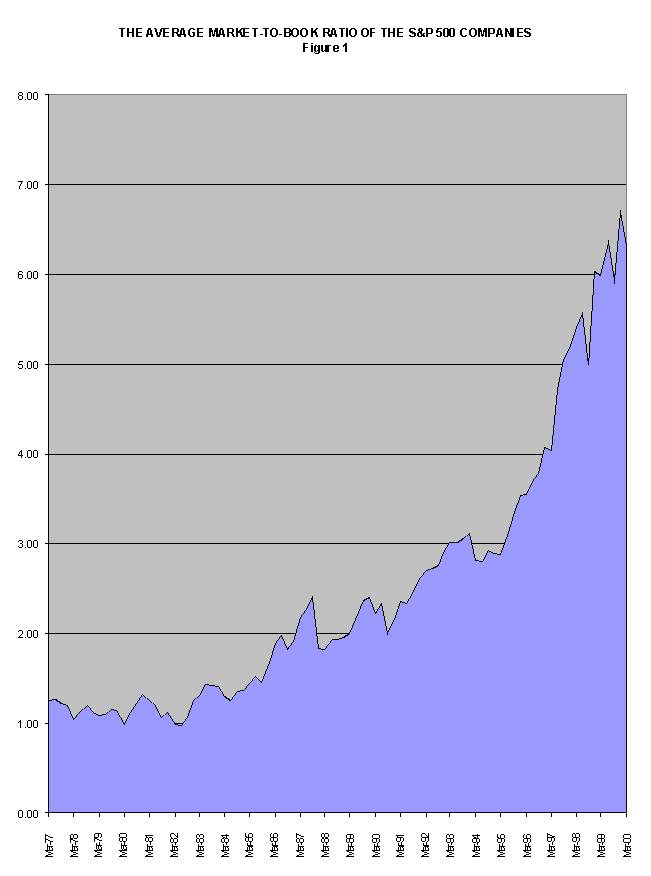
The
market-to-book (M/B) value (i.e., the ratio of the capital market value of
companies to their net asset value, as stated on their balance sheets) is frequently
invoked to motivate the focus on intangibles. As indicated by Figure 1, the
mean M/B ratio of the S&P 500 companies (the largest 500 companies in the
USA) has continuously increased since the early 1980s, reaching the value of
6.3 in March 2000. This suggests that, of every $6 of market value, only $1
appears on the balance sheet, while the remaining $5 represent intangible
assets.
Hence, some argue, the current focus on intangibles is warranted. However, a
longer historical perspective reveals that in the 1950s and 1960s, the mean M/B
ratio was also substantially greater than 1 (see Hall, 1999). Morever, as
Figure 1 indicates, the market-to-book ratio hovered near unity in the late
1970s and early 1980s. Where were intangible assets then? Surely, firms
possessed some intangibles (patents, brands) prior to the mid-1980s. Merck had
significant pharmaceutical patents, and Coca-Cola had a precious brand. Are
recent intangibles different than previous ones, or more valuable now than in
the 1970s? What is unique about current intangibles?
Intangibles
existed, of course, in the 1970s and much earlier, dating back to the dawn of
civilization. Whenever ideas were put to use in households, fields, and
workshops, intangibles were created. Breakthrough inventions, such as
electricity, internal combustion engines, the telephone, and pharmaceutical
products, have created waves of intangibles. Intangibles (intellectual capital
or knowledge assets) are surely not a new phenomenon.
What is
new, driving the recent (since the mid-1980s) surge in intangibles, is the
unique combination of two related economic forces: (a) intensified
business competition, brought about by the globalization of trade and
deregulation in key economic sectors (e.g., telecommunications, electricity,
transportation, financial services), and (b) the advent of information
technologies (IT), most recently exemplified by the Internet. These two
fundamental developments—one economic/political, the other technological—have
dramatically changed the structure of corporations and have catapulted
intangibles into the role of the major value driver of businesses in developed
economies. The following case of Ford Motor Co. demonstrates both the change in
corporate structure and the consequent growth of intangible investments,
typical of 21st-century businesses.
Ford [Motor Co.] announced in April 2000 that it would
return $10 billion to shareholders, capital that would not be needed by the
new, leaner Ford. It was already in the process of spinning off most of its
parts plants into Visteon. Henceforth, it would be just another supplier to
Ford…While shedding physical assets, Ford has been investing in intangible
assets. In the past few years, it has spent well over $12 billion to acquire
prestigious brand names: Jaguar, Aston Martin, Volvo and Land Rover. None of
these marquees brought much in the way of plant and equipment, but plant and
equipment isn’t what the new business model is about. It’s about brands and
brand building and consumer relationships. In the New Economy, quite
deliberately, Ford has been selling things you can touch and buying what exists
only in the consumer’s minds…The Internet facilitates these changes in two big
ways. In a B2B sense, it facilitates the substitution of an outside supply
chain for company-owned manufacturing. In a B2C sense, it facilitates a
continuous interaction with consumers that offers myriad ways to enhance the
brand value…Decapitalized, brand-owning companies can earn huge returns on
their capital and grow faster, unencumbered by factories and masses of manual
workers. Those are the things that the stock market rewards with high
price/earnings ratios. (Forbes, July 17, 2000, pp. 30–34)
Ford
is thus restructuring itself, in particular de-integrating vertically (e.g.,
spinning off the manufacturing of automotive parts), shedding physical assets,
investing heavily in intangibles, and facilitating these changes by increased
reliance on the Internet. The emergence of intangibles (mainly brands, in
Ford’s case) as the major driver of corporate value at Ford is thus the direct
result of the two forces mentioned above: competition-induced corporate
restructuring facilitated by emerging information technology.
Ford is
not an aberration. Driven by severe competitive pressures (globalization),
rapid product and service innovation, and deregulation of key industries
(telecommunications, financial services, and currently electrical utilities),
companies in practically every economic sector started in the early to
mid-1980s to restructure themselves in a fundamental and far-reaching manner.
Vertically integrated industrial-era companies, intensive in physical assets,
were primarily designed to exploit economies of scale.
However, these production-centered economies were sooner or later exhausted and
could no longer be counted on to provide a sustained competitive advantage in
the new environment:
…traditional economies of scale based on manufacturing have
generally been exhausted at scales well below total market dominance, at least
in the large U.S. market. In other words, positive feedback based on
supply-side economies of scale ran into natural limits, at which point negative
feedback took over. These limits often arose out of the difficulties of
managing enormous organizations. (Shapiro and Varian, 1999, p. 179)
Once
economies of scale in production have been essentially exhausted, production
activities, intensive in physical assets, became commoditized and failed to
provide a sustained competitive advantage. Companies responded to this
commoditization of manufacturing by: (a) de-verticalizing
themselves, namely outsourcing activities (e.g., Ford’s parts production) that
do not confer significant competitive advantages, and (b) strengthening
the emphasis on innovation as the major source of sustained competitive
advantage. These two fundamental changes in the structure and strategic focus
of business enterprises gave rise to the ascendance of intangibles.
While less
vertically integrated than its predecessors, the 21st-century
corporation is much more connected than industrial-era enterprises. The
vertical integration of traditional companies is increasingly substituted by a
web of close collaborations and alliances with suppliers, customers, and
employees, all facilitated by information technology, particularly the
Internet. Traditional economies of scale are complemented and sometimes
substituted by economies of network, where the economic
gains are primarily derived from relationships with suppliers, customers, and
sometimes even competitors (e.g., Ford and General Motors launching a joint
Internet-based supplies exchange).
Whereas
the linkages among parties (or corporate divisions) to the industrial era,
vertically-integrated companies were mostly physical (e.g., conveyor belts
connecting auto parts divisions to assemblers, railway networks, etc.), the
current essential linkages between firms and their suppliers and customers are
mostly virtual, reliant upon intangibles: Cisco’s web-based system of product
installation and maintenance, linking the company to its customers; Merck’s 100
R&D alliances; and Wal-Mart’s computerized supply chain are examples of such
intangible linkages. These highly valuable intangibles, often termed organizational
capital, where not major assets (value drivers) prior to the 1980s. In
the modern corporation, these organizational intangibles are among the most
valuable corporate assets.
The 21st-century
corporation is not only more “connected” than its industrial-era predecessor,
it is also more dependent on its employees. Economic developments have
considerably weakened firms’ control over human resources.
At the very time human capital has become more
important, firms grip on it weakened for two reasons. First, the easier access
to financing has increased employees’ outside options [going to work for a
startup]. Second, the opening up of world trade created the space for many
independent suppliers. This generated many alternative employment
opportunities, making employees’ human capital less specific to their current
employer. (Zingales, 2000, pp. 29–30)
The increasing rate of employee turnover across
many economic sectors testifies to the deteriorating bonds between employers
and employees. Obviously,
firms that are able to maintain a stable labor force and secure (or
appropriate) a significant portion of the value created by employees possess
valuable employee-related intangibles.
The enormous loss from employee turnover is demonstrated
by the finding that 71% of the firms in the “Inc. 500” list (a group of young,
fast-growing companies) were established by persons who replicated or modified
innovations developed within their former employers (Bhide, 2000). This
suggests the magnitude of the loss from failure to retain key employees and
secure the value created by them. Specific training programs, compensation
practices (e.g., substantial stock-based compensation awarded deep down the corporate
hierarchy), and innovative arrangements, such as the establishment of
entrepreneurial centers within corporations, were found to be effective in
stabilizing the workforce. Like organizational capital, such employee-related
intangibles were not prominent in industrial-era enterprises, which exerted
significant control over their employees. Human resource intangibles are now
prominent in successful corporations.
Innovation
has always been an important activity of individuals (e.g., Edison, Bell) and
business enterprises. The prospects of abnormal profits or monopoly rents,
protected for a certain period by patents or “first-mover advantages,” have
always provided strong incentives to innovate. The great scientific and industrial
inventions of the 19th and 20th centuries—electricity,
the internal combustion engine, chemical and pharmaceutical discoveries,
communications and information technologies—attest to the age-long strong
incentives to innovate. Clearly, innovation is not unique to the current
economic environment.
What is
unique to the modern corporation is the urgency to innovate. Given the
decreasing economies of scale (efficiency gains) from production, discussed
above, coupled with the ever-increasing competitive pressures, innovation has
become a matter of corporate survival in recent decades. This urgency to
innovate is reflected in the sharp increase in the number of professional
workers engaged in innovation (creative activities). Table 1, reproduced from
Nakamura (2000, p. 17), indicates that during the 70 years, 1900–1970, the
number of creative workers increased by 2.4 million, while during the last 30
years (1970–1999), this employment sector increased by 5 million individuals.
Note also the corresponding increases of creative workers in proportion
to all employees—from 3.8% in 1980 to 5.7% in 1999. If one expands Nakamura’s
definition of creative workers to include service sectors, such as
financial-sector employees engaged in the development of products and services
(e.g., derivative/option products, risk management tools), the recent growth in
the number of people directly engaged in innovation would be higher still.
|
TABLE
1
|
|
Year
|
Professional Creative Workers†
(Millions)
|
Proportion of all Employment
(%)
|
|
1999
|
7.6
|
5.7
|
|
1990
|
5.6
|
4.7
|
|
1980
|
3.7
|
3.8
|
|
1970
|
2.6
|
3.3
|
|
1960
|
1.6
|
2.3
|
|
1950
|
1.1
|
1.9
|
|
1900
|
0.2
|
0.7
|
Sources: 1900–1980, Censuses of Population.
1990 and 1999, Employment and Earnings, January 1991 and January 2000.
†Professional creative workers comprise architects,
engineers, mathematical and computer scientists; as well as urban planners,
writers, artists, entertainers, and athletes.
While many 19th- and early 20th-century
innovations were made by individuals (electricity, telephone, and television,
to name a few) and were subsequently developed by corporations; by the second
half of the 20th century, innovation became a major corporate
activity, with massive resources devoted to it (e.g. U.S. corporate
R&D expenditures, one of several forms of investment in innovation, reached
the level of $180B in 1999).
Success and leadership, even in traditional industries, can now be secured only
by continuous innovation. Enron (electricity and gas production), Wal-Mart
(retail), and Corning (housewares) are prime examples of companies that
leverage major innovations to gain leading positions in their industries, and
sometimes even creating new fields (e.g., energy trading, in Enron’s case).
Innovations
are created primarily by investment in intangibles. The new products, services,
and processes that are generated by the innovation process (e.g., new drugs,
ATM machines, or Internet-based distribution channels), are the outcomes of
investment in R&D, acquired technology, employee training, customer
acquisition costs, etc. When such investments are commercially successful, and
are protected by patents or “first mover” advantages, intangible assets become
the major source of corporate value and growth.
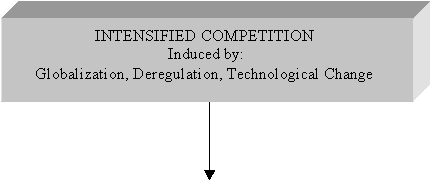
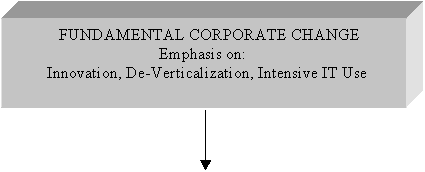
Summarizing, why the
current interest in intangibles? As depicted in Figure 2, the intensified
competition in practically all business sectors, brought about by globalization
of trade, far-reaching deregulation, and technological changes (e.g., the
Internet), forces business enterprises to radically change their business
models. Most of these changes revolve around de- verticalization (e.g.,
outsourcing) and innovation. Intangibles are the natural outgrowth of both:
de-verticalization is achieved by a substitution of intangibles for physical
assets, and innovation is achieved primarily by investment in intangibles.
Hence, the recent growth of and focus on intangible assets.
Figure 2
THE ASCENDENCY OF INTANGIBLES
I.3 So What?
(Who Should Care About Intangibles?)
True, intangible capital is large
and fast growing, but so too are the physical and financial (stock, bonds)
investments of the corporate sector. Why should policy makers, managers, and
investors be particularly concerned about intangibles? What justifies a wide
public discourse on the issue? Books and treaties on intangibles (intellectual
capital) often focus on the deficient accounting and reporting of intangible
investments in corporate financial statements and proceed to argue that these
information deficiencies call for various remedies. Others argue that the
inadequate internal information systems dealing with intangibles adversely
affect managerial decisions, and offer remedies.
Generally missing from these claims concerning information
deficiencies and the suggested remedies are two important elements: (a)
A thorough examination of the reasons for the information deficiencies.
Why is it that, despite the growing awareness of the importance of intangible
assets, they remain almost universally ignored in accounting and reporting
procedures? Obviously, any useful prescriptions concerning intangibles-related
information require a thorough understanding of the impediments to change. (b)
A careful empirical documentation of the adverse social consequences or
failures due to the presumed deficiencies. Shortcomings of a specific
information system, in this case accounting for intangibles in internal and
external corporate reports, will not result in adverse consequences if decision
makers (managers, investors) can obtain the required information from other
sources. Investors may, for example, obtain information about intangibles
through meetings or conference calls with corporate officers or from research
reports issued by analysts.
Managers, too, may supplement the deficient internal accounting system with
specific information on intangibles (e.g., patents per R&D or employee
retention indicators). Accordingly, convincing prescriptions for change in the
management and measurement of intangibles should be based on documented
deficiencies, or harmful consequences, rather than on ad hoc arguments about
information shortcomings.
These two
themes—a fundamental understanding of the attributes and socio/political
context of intangibles, and an empirical documentation of adverse consequences related
to intangibles—are pursued in Parts II and III of this report. The former
outlines the “economics of intangibles,” while the latter elaborates on the
managerial and capital market impacts of the recent prominence of intangibles
in firms’ production functions. This analysis clarifies the relevance of
intangibles to wide constituencies, with the following groups standing to gain
most from change:
¨
Corporate managers and
their shareholders: Evidence indicates
that intangible investments are associated with excessive cost of capital
(lemons’ discount, in the economic parlance), beyond what is called for by the
higher-than-average risk of these investments. Excessive cost of capital, in
turn, hinders investment and growth. Managers and investors should, therefore,
be interested in mechanisms aimed at alleviating the excess cost of capital.
¨
Investors and capital
market regulators: Research documents
the existence of above-average information asymmetry (differences in
information about firms’ fundamentals between corporate insiders and outsiders)
in intangibles-intensive companies. Economic theory suggests that large and
persistent information asymmetries between parties to a contract or a social
arrangement lead to undesirable consequences, such as systematic losses to the
less informed parties and thin volume of trade. Investors and policymakers
should, therefore be interested in systematically decreasing the
intangibles-related information asymmetries.
¨
Accounting standard
setters, corporate boards: Empirical
evidence indicates that the deficient accounting for intangibles facilitates
the release of biased and even fraudulent financial reports. This should
obviously be of concern to regulators of financial information (e.g., SEC,
FASB) and corporate board members who rely heavily on accounting-based
information to monitor managerial activities.
¨
Policymakers: Financial statement
information of the corporate sector is a major input into the national
accounts. The various intangibles-related deficiencies in financial information
adversely affect public policymaking in key areas, such as the assessment of
fiscal policy (e.g., R&D tax incentives) supporting innovation, optimal
protection of intellectual property (e.g., scope of patents), and the
desirability of “industrial policy.”
Thus, a
thorough examination of the attributes of intangibles (the “economics of
intangibles”), as well as the evidence on specific harmful consequences related
to intangibles, points at wide constituencies that should be concerned about the
ensuing consequences.
1.4. Takeaway
Points
¨
The recent prominence of intangible assets is the
result of the confluence of two major forces: substantive changes in the
structure of business enterprises and far-reaching information technology and
scientific innovations.
¨
Intangibles are inherently
different form physical and financial assets. Managerial and regulatory systems
are slow to adapt to these differences, resulting in widespread adverse social
consequences that should be of concern to managers, investors, and
policymakers.
¨
A productive discourse on
intangibles should be based on a thorough analysis of the economics of
intangibles, an understanding of the incentive and motives (particularly
aversion to change) of the major players (executives, financial analysts,
accountants); as well as a careful, empirical documentation of the economic
consequences of the rise of intangibles.
References
Bhide, A., 2000, The Origin and
Evolution of New Businesses, Oxford University Press, New York.
Chandler A., 1990, Scale and Scope,
Bellknap Press, Cambridge, MA.
Chandler, A., 1977, The Visible Hand,
Bellknap Press, Cambridge, MA.
Gordon, Robert, 2000, Interpreting
the “One Big Wave” in U.S. long-term productivity growth, National Bureau of
Economic Research, Working Paper 7752.
Hall, Robert, 1999. The stock market
and capital accumulation, NBER Working Paper No. 7180.
Hall, Robert, 2000, E-Capital: The
link between the stock market and the labor market in the 1990s, Working Paper,
Hoover Institution and Stanford University.
Nakamura, Leonard, 2000, Economics
and the new economy: The invisible hand meets creative destruction, Federal
Reserve Bank of Philadelphia, Business Review (July/August, pp. 15–30).
Romer, Paul, 1990, Endogenous
technical change, Journal of Political Economy, 98, S71–S102.
Romer, Paul, 1998, Bank of America
Roundtable on the soft revolution, Journal of Applied Corporate Finance,
Summer, 9–14.
Shapiro C., and H. Varian, 1999,
Information Rules, Harvard Business School Press, Boston, MA.
Zingales, L., 2000, In search
of new foundations, National Bureau of Economic Research, Working Paper 7706.
The extensive and fast growing
literature on intangibles (intellectual capital) generally extols the potential
of these assets to create value and generate growth. Scalability, network
effects and increasing returns are the major themes (some would say buzzwords)
of these writings. Often overlooked in these writings is the fact that
intangibles, like physical and financial assets are subject to the fundamental
economic laws of costs and benefits. The benefits from scalability, network
effects, and other virtues of intangibles come at a price—sometimes a steep
one. To enhance the scalability of a software program, for example, it is often
required to relinquish control over it (e.g., open source systems).
The fundamental cost–benefit tension
underlies the economics of intangibles, as it does the economics of other forms
of capital. A thorough understanding of the managerial, valuation, and policy
issues related to intangibles, therefore, requires a careful analysis of this
tension.
This part of the report is
accordingly devoted to outlining the essentials of the economics of
intangibles. It opens with a discussion of the two major drivers of benefits
from intangibles—nonrivalry (nonscarcity) and network effects—and proceeds with
the discussion of the three major cost drivers (value detractors), namely,
partial excludability, inherent risk, and non-tradadability. This unified
cost–benefit approach to the analysis of intangibles is my definition of the economics
of intangible capital.
Physical,
human, and financial assets are “rival assets” in the sense that alternative uses
compete for the services of these assets. In particular, a specific deployment
of rival assets precludes them from being used elsewhere. Such rivalry leads to
positive opportunity costs for rival assets, where the cost is the “opportunity
forgone,” namely the benefit from deploying the asset in the next-best
alternative. Thus, for example, when United Airlines assigns a Boeing 747 plane
to the San Francisco–London route, that airplane cannot be used at the same
time in the San Francisco–Tokyo route. Likewise with the airplane’s crew and
the capital used to finance its acquisition. Physical, human, and financial
assets are thus rival or scarce assets, where the scarcity is reflected by the
cost of using the assets (the opportunity forgone).
In contrast, intangible
assets are, in general, nonrival; they can be deployed at the same
time in multiple uses, where a given deployment does not detract from the
usefulness of the asset in other deployments. Accordingly, many intangible
inputs have zero or negligible opportunity costs. Thus, for example, while
United’s airplanes and crew can be used during a given time period in one route
only, its reservation system (a knowledge-intensive asset) or Frequent Flyer
program (organizational capital) can serve at the same time a potentially
unlimited number of customers. Stated differently, nothing is given up (no
opportunity forgone) when the reservation system fulfills a customer’s order.
Once an airline reservation system has been developed, its usefulness is
limited only by the potential size of the market, and, of course by
competitors’ actions, but not by its own use.
A major contributor to
the nonrivalry of intangibles is the fact that these assets are generally
characterized by large fixed (sunk) cost and negligible marginal (incremental)
cost. The development of a drug or a software program generally requires heavy
initial investment, while the cost of producing the pills or software diskettes
is negligible. Many such
intangible investments are not subject to the diminishing returns
characteristic of physical assets.
The nonrivalry (or nonscarcity) attribute of
intangibles—the ability to use such assets in simultaneous and repetitive
applications without diminishing their usefulness—is a major value driver at
the business enterprise as well as the national level. Whereas physical and
financial assets can be leveraged to a limited degree only, by exploiting
economies of scale or scope in production (e.g., a plant can be used for at
most three shifts a day), the leveraging of intangibles to generate
benefits—the scalability of these assets—is generally limited only by the size
of the market. The
usefulness of the ideas, knowledge, and research embedded in a new drug or a
computer operating system are not limited by decreasing returns to scale
typical of physical assets (e.g., as production is expanded from two to three
shifts, returns are decreasing due to wage premium paid for third shift,
employee fatigue, etc.). In contrast, intangibles are often characterized by increasing
returns to scale. An investment in the development of a drug or a financial
instrument (e.g., a risk-hedging mechanism) is often leveraged in the
development of successor drugs and financial instruments. Information is
cumulative, goes the saying.
The case of Sabre, American Airlines’ reservation and
information system, illustrates the unique value creation potential of
intangibles in contrast to that of tangible assets.
On October 11, 1996, AMR, the parent company of American Airlines, sold (an
equity carveout) 18% of its Sabre subsidiary in an initial public offering that
valued Sabre at $3.3B. On the previous day, AMR had a total market value
(including Sabre) of about $6.5B. Thus, a reservation system generating income
from travel agents and other users of its services constituted one half of the
market value of the world’s second largest airline, while the remaining half
reflected American’s 650 airplanes (in 1996) and all other physical and
financial assets, including valuable landing rights. A $40M R&D investment
in Sabre during the 1960s and 1970s mushroomed into a market value of $3.3B in
the mid-1990s. By October 30, 1999, Sabre’s share in the total market value of
AMR increased to 60%, demonstrating the value creation potential (scalability)
of intangibles, relative to that of tangible assets.
Intangible capital takes various forms. It can be
protected by legal rights (often termed intellectual property), such as patents
and trademarks, or be in an unprotected, know-how state. It can be embedded in
durable products, such as the software operating machine tools, or exist as a
“stand alone,” such as brands. Intangible capital is increasingly present in
the form “organizational assets”—unique organizational and managerial designs
of business enterprises. Here, too, the ability to leverage organizational
capital to achieve efficiencies and create value far exceeds the value creation
ability of physical assets. Consider the case of Cisco Systems, as told by The
Economist (June 26, 1999, p. 10 of Survey).
The first bottleneck [to
fast growth] was in after-sales support. The equipment that Cisco sells,
however good, does not just run first time out of the box. Networks have to be
carefully configured, and each mix of kit ordered is highly customized.
Customers expected continuous support, yet highly trained engineers who could
deal with the full range of technical problems were hard to find. Besides, they
were being submerged by the daily flood of relatively trial queries.
The
answer turned out to be the Web. Cisco decided to put as much of its support as
possible online so that customers would be able to resolve most workaday
problems on their own, leaving the engineers free to do the heavy lifting. It
was an almost instant success, becoming in Mrs. Bostrom’s [head of Cisco’s
Internet Solutions Group] words, ‘a self-inflating balloon of knowledge.’
Cisco’s customers did not just go to the website to get information, they
started using it to share their own experiences with both Cisco itself and other
customers.
Here, then, is a case where a scarce, rival input (Cisco’s
engineers and maintenance personnel) was replaced to a large extent by a
nonrival intangible asset (online software and instruction programs), which was
then leveraged to a “balloon of knowledge” and fortune, estimated by Cisco’s
CFO to save $1.5B annually (an amount close to Cisco’s entire 1998 net income).
The benefits
of intangibles (knowledge) often exhibit “increasing returns to scale,” as
Grossman and Helpman (1994, p. 31) note:
Knowledge is cumulative,
with each idea building on the last, whereas machines deteriorate and must be
replaced. In that sense, every knowledge-oriented dollar makes a productivity
contribution on the margin, while perhaps three-quarters of private investment
in machinery and equipment is simply to replace depreciation.
Thus, investment in drug or software development, even if failing
the market test, often guides and benefits future drug or software development,
which is yet another scalability aspect of intangibles. The scalability of
intangibles, emanating from their nonrivalry and increasing-returns properties,
is reflected, among other things, in the market dominance of many
intangibles-intensive enterprises. Intel Corp. has a 77% market share of PC microprocessors,
Cisco Systems has 73% of the router market, while 78% of Internet users access
it through America Online, and eBay conducts 70% of on-line auctions.
Such market dominance is unheard of in traditional, capital-asset-intensive
sectors, where even the most efficient and well-managed enterprises (e.g.,
Exxon, GE in appliances, or Ford) have market shares of less than 25%.
Summarizing, the
nonrivalry attribute of intangibles—the fact that a specific deployment of an
intangible asset does not detract from its concurrent usefulness in other
deployments (e.g., the use of Amazon.com’s website by customer A does not
preclude customer B from using it at the same time)—is a major value driver of
intangible assets. This value creation potential, often referred to as the
scalability of intangibles, is limited only by the size of the market. In
contrast, the rivalry of physical assets—the preclusion of these assets from
multiple, concurrent uses—significantly restricts their scalability.
The economics of
networks can be succinctly summarized: One’s benefit from being part of a
network increases with the number of other persons or enterprises connected to
it. In networks, bigger is better.
Networks can be physical, like landline telephone and railroad networks, or
virtual like Windows 2000 or the VHS videocassette networks of users. The
benefits from a network increase with its size, primarily because there are
more people with whom to interact or conduct business. Thus, the benefits from
a cellular phone system, whose reach is limited to the Manhattan Borough, are
substantially inferior to the GSM cellular system that can reach any place in
Europe. Furthermore, the larger the size of the network, the greater the
benefits derived from the development of applications (Software programs, CDs,
Videocassettes). The payback from Java, for example, is still restricted
because some application writers are not convinced that Java will become a
sufficiently universal system. Increased network size also enhances the rate of
learning and adoption of new technologies, further enhancing the benefits
(network externalities) in network markets.
The fact that benefits in network markets increase with
the size of the network often creates “positive feedback” in which success
begets success. A technology that gains an initial, even small, lead may
quickly expand and dominate the market, because users, with their eyes to the
future, select technologies that they expect to prevail. Users’ expectations of
success are crucial in network markets, enhancing ever more the positive
feedback effect (see Economides 1996, for a survey of network effects.).
The Sabre case, discussed above (Section II.1),
demonstrates the potency of network effects vs. traditional economies of scale
characteristic of physical assets. American Airlines obviously attempts to take
advantage of every economy-of-scale opportunity in its airline operations, yet
its market share is relatively stable, approximately 16–17% percent.
Sabre, on the other hand, exploiting network effects, had a 40–50% market share
in the North America market in 1998.
The large market share of Sabre is largely due to network effects—it quickly
became the preferred reservation system for travel agents. The larger the
number of agents using Sabre, the larger was the attraction for airlines,
hotels, car rental companies, and other suppliers of travel-related services to
join the Sabre network.
Large networks are facilitated by standards.
Compatibility with an accepted standard is key to success in network markets.
Classic standards are the VHS system for videotapes, the 3½" standard for
computer disks, and the Dow Jones Industrial Average (DJIA).
Standards expand network
externalities, reduce [consumer] uncertainty, and reduce consumer lock-in.
Standards, also shift competition form a winner-take-all battle to a more
conventional struggle for market share, from the present to the future, from
features to prices, and from systems to components (Shapiro and Varian 1999, p.
258).
Network effects are prevalent in
computer, software, telecommunications and consumer electronics markets.
Similar, but informationally induced network effects, exist in pharmaceutical
markets, when “the use of a drug by others [doctors] influences one’s
perceptions about its efficiency, safety, and ‘acceptability,’ and thus affects
its valuation and rate of adoption.” (Berndt et al. 1999, pp. 1–2). Thus,
demand for a pharmaceutical product by patients and physicians, like demand for
a software program or a computer operating system, depends in part on the
number of other patients that are using the drug, thereby creating a network
effect.
Network markets are sometimes
characterized by “tipping,” where even a small real or perceived advantage of a
product or system can lead to a very large future advantage, providing the
product/system becomes the standard. It is often argued that standards or
dominant positions, once established are difficult to change, even with
superior technology, since consumers are “locked into the standard” (e.g.,
Farrell and Shapiro 1989, Katz and Shapiro 1985). The possibility of tipping
generally leads to intense competition at the early stages of market evolution,
as firms struggle to win a dominant position by such means as moving first,
using “penetration pricing” (low or zero prices) to quickly gain customers
(e.g., America Online’s early strategy of offering free subscriptions), or
merging with providers of complement products (e.g., AOL’s acquisition of
Netscape). The
“winner-take-all” nature of network markets increases the uncertainty facing
producers: The current (year 2000) fierce competition in e-commerce to gain
market share and dominant position manifests the characteristics of network
markets. In such markets, it is sometimes argued the best product is not always
guaranteed to win consumers’ preference. Being locked into an inferior product
and reluctant to sustain the cost of switching to an improved one, consumers
may stay with the inferior product.
The essence of network
effects and positive feedback is demonstrated by the Nintendo example (Shapiro
and Varian, 1999, p. 178):
When Nintendo entered
the U.S. market for home video games in 1985, the market was considered
saturated, and Atari, the dominant firm in the previous generation, had shown
little interest in rejuvenating the market. Yet by Christmas 1986, the Nintendo
Entertainment System (NES) was the hottest toy on the market. The very
popularity of the NES fueled more demand and enticed more game developers to
write games to the Nintendo system, making the system yet more attractive.
Nintendo managed the most difficult of high-tech tricks: to hop on the
positive-feedback curve while retaining strong control over its technology.
Every independent game developer paid royalties to Nintendo. They even promised
not to make their games available on rival systems for two years following
their release!
What does all this have to do with intangibles? Surely, network
effects are present in tangibles-intensive industries too. Transportation
networks (railroads, trucking, airlines, shipping), fixed-line telephones, car
rental companies, and ATM machines are but a few examples of tangible-intensive
industries in which network effects can be exploited. In recent years, however,
intangibles are at the core of most industries/sectors characterized by network
effects. There is the reason.
Network effects
arise primarily in situations where consumers/users value large networks.
As a Lexus owner, I do not care much about the size of the Lexus owners’
network. However, as an owner of a fax machine, cellular phone, or
high-definition television (HDTV), I do care a lot about the size of the
network. The usefulness to me of a fax machine, a cellular phone, or a computer
operating system increases with the number of other users: more
people to communicate/transact with, more applications developed for the
network. So, quite simply, network effects exist where there are networks of
users. But increasingly, at the core of important networks lies an idea, which
was subsequently developed into a product/service, and for which property
(ownership) rights are secured by patents, trademarks, or a strong brand.
In other words, at the core of network markets lies an intangible, characterized
by the triplet: idea–product–control. Examples of such intangibles propelling
network markets are the Nintendo Entertainment System mentioned above,
Microsoft’s operating systems, Lotus spreadsheets, the wireless application
protocol (WAP) for mobile browsers, Intel’s Pentium chips, and Visa cards.
Intangibles are
not only present at the core, but also at the periphery of network markets. I
refer here to the intangibles formed by alliances that contribute to the
network effects:
An alliance formed by a
group of companies for the express purpose of promoting a specific technology
or standard…an alliance built like a web around a sponsor, a central actor that
collects royalties from others [or makes the technology freely available to
alliance members but not to others], preserves proprietary rights over key
components of the network and or maintains control over the evolution of the
technology. (Shapiro and Varian, 1999, pp. 201–202).
An example of a set of alliances aimed at securing a competitive
advantage and reaping network effects is provided thus:
In September, Palm
announced an agreement with Nokia Corp., the Swedish mobile-phone maker,
followed by another licensing deal in October with Japanese consumer
electronics giant Sony Corp. The deal provided Palm’s new partners with Palm
technology for their phones and other hand-held gadgets.
The
two high-profile deals had a domino effect on software developers. Suddenly
realizing how serious large consumer-electronics firms were about the
hand-held-device market, the developers began flocking to Palm in late 1999,
asking to create applications for the gadget. ‘Those licensing deals made it
clear to us that Palm was a company with legs,’ says Jason Devitt, chief
executive of Vindigo, a New York firm that has since created a local
restaurant-and-event-finder for the Palm. Thousands of other software
developers flocked to Palm, including Pocket Sensei, which makes user interface
software, and Actioneer Inc., which makes a notes-reminder program. (The
Wall Street Journal, August 8, 2000, p. A14)
Summarizing,
network effects, a hallmark of advanced-technology, information-based
industries, are increasingly characterized by product-related intangibles
(unique products/services protected by intellectual property) at the core, and
alliance-related intangibles at the periphery. Network effects, accordingly,
are often predicated on intangibles assets.
In the preceding two
sections, I have elaborated on the substantial value creation (scalability) potential
of intangible assets that result from the nonrivalry (nonscarcity), increasing
returns, and positive feedback (network effects) attributes, often
characterizing these assets. Such value creation potential is the subject of
numerous “new economy” books and articles exhorting the wonders of intellectual
capital or knowledge assets. A serious discussion of intangibles, however, must
tackle the following “if it’s so good” conundrum:
If intangibles are such potent value creators, what limits
the expansion of these assets? Why are not all firms virtual, in the
sense of having only, or primarily intangible capital with no or only
negligible physical capital? To be sure, a growing number of firms are pretty
close to virtual. Microsoft’s net physical and financial assets in June 2000,
for example, constituted less than 10% of its market value, and Cisco’s
physical and financial assets accounted for 5% of its market value, rendering
these companies almost virtual. However, companies in most economic sectors—such
as chemicals, transportation, and manufacturers of durable goods—are far from
virtual. Such companies have significant investments in physical assets (e.g.,
property, plant and equipment, inventories), and many are intangibles poor.
Among the most notable successes in online (Internet) selling are
physical-heavy behemoths like J.C. Penny Co. (“Penny Wise,” Forbes, September
4, 2000, p. 72). Why are these companies not substituting intangibles for
physical assets? What limits the growth of intangibles?
An important limiting factor is the size of market and
growth potential. As was made clear in the preceding sections, the
scalability of intangibles is predicated on the size of the market. Sabre’s
value and growth potential is substantial because of the huge travel and
related services market. Similarly, the potential of many business-to-business
(B2B) Internet exchanges derives from the enormous size of the market they plan
to service, such as chemicals, auto parts, or aerospace parts. However, in
relatively small, low-growth markets—such as gold and other precious metals,
certain luxury food products (e.g. wine and liquors), or appliances—the
usefulness of intangibles is restricted. Thus, market size and potential growth
limit the expansion of intangible assets.
However, the major limitation on the use and growth of
intangibles is “managerial diseconomies.” Intangible assets are, in general,
substantially more difficult to manage and operate than tangible assets. For
one, the well-defined property rights of physical and financial assets,
relative to the often-hazy property rights of intangibles, considerably
facilitate the management of the former. American Airlines’ executives, for
example, do not lose sleep about competitors misappropriating their planes and
facilities, but preventing competitors from imitating American’s leading
reservation system (Sabre) is a major and continuous challenge. The virtual
nature of intangibles further complicates their management. Thus, for example,
identifying unused physical capacity (half empty airplanes) and taking
corrective actions (e.g., changing price policy) are straightforward tasks,
whereas optimizing network effects from a new technology is a harrowing
challenge.
Contributing to the difficulties of managing intangibles
is the fact that managerial information systems (cost accounting), which
provide managers with information on costs, revenues, and deviations from
budgets, are almost exclusively geared to industrial-age physical and labor
inputs. The costs that are commonly allocated to products, processes, or
activities (“Activity-Based Costing”) are raw materials, labor, and overhead
(e.g., depreciation). Intangible inputs, such as R&D and customer
acquisition costs, are considered period expenses, not allocated to products
and processes. Such a tangibles-based managerial information systems are wholly
inadequate for the management of knowledge-based enterprises.
Diseconomies resulting from limited capacity to manage
intangibles are the major factor restricting the use and growth of these
assets. On the positive side, overcoming such diseconomies by improving
information systems and the management of intangibles promises enormous
rewards. The following three sections elaborate on the unique attributes of
intangibles, which create the challenges of managerial diseconomies.
The benefits of
tangible and financial assets can be effectively secured (appropriated) by
their owners. Thus, for example, investors in securities or commercial real
estate enjoy to the fullest the benefits (or sustain the losses) of these
investments. The well-defined property rights of physical and financial assets
enable owners to effectively exclude others from enjoying the benefits
of these assets.
In the case of intangible investments, however,
non-owners can rarely be precluded from enjoying some of the benefits of the
investments. For example, when a company invests in training its employees
(e.g., on-the-job training or tuition payment for an MBA education), other
companies (and society at large) will benefit from such investments, when the
trained employees switch employers. The investing company cannot effectively
exclude others from the benefits of training.
Even in the case of patented inventions, where property rights are legally well
defined, there are substantial benefits to non-owners, generally termed
“spillovers.” Obviously, after patent expiration (20 years from application, in
the USA), the invention can be used freely by non-owners, such as in generic
drug manufacturing. But even prior to patent expiration, there are often
significant spillovers through imitation (product reengineering) by
competitors. The large number of patent infringement lawsuits attests to the
considerable difficulties and the high cost of appropriating the benefits of
patents. Indeed, a recent survey (Cohen et al., 1997) concluded that the
effectiveness of patents as a means of appropriating R&D returns has
declined since the early 1980s, despite the strengthening of patent protection.
U.S. manufacturing firms, the survey reports, rely more on secrecy and lead
time (“first to market”) to recoup the R&D investment, rather than on the
protection of the legal patent..
Furthermore, significant international spillovers occur primarily because
property rights protection is not effectively enforced in many countries,
resulting in uninhibited copying and imitation of R&D products (drugs,
software). From Amazon.com 1999 10-K report: “Effective trademark, service mark,
copyright, patent and trade secret protection may not be available in every
country in which our products and services are made available online. The
protection of our intellectual property may require the expenditure of
significant financial and managerial resources.” Innovation spillovers are thus
the consequence of the imperfectly defined and enforced property rights of
intangibles.
A striking example of the partial excludability
characteristic of intangibles, and the existence of significant spillovers, is
provided by the transistor, which was invented at the Bell Laboratories.
Bell’s R&D investment in the 1950s and 1960s leading to the transistor’s
invention was substantial. It is estimated at approximately $160M.
However, Bell’s basic patents in transistors were made available to other
enterprises for a paltry payment of $25,000 advance royalty because of an
antitrust lawsuit against Bell. Licensing income earned by AT&T on
transistors thus amounted to an insignificant fraction of its R&D costs.
Obviously, of the huge private and social values created by the transistor for
a large number of technology and consumer product companies, AT&T—its
inventor—appropriated only a negligible fraction. True to its tradition,
AT&T managed more recently to miss on the benefits of another major
invention: the cellular (wireless) phone technology. This technology was
developed at Bell Labs in the late 1970s, but was deemed by AT&T and its
outside consultants commercially useless. Consequently, AT&T abandoned the
development of cellular telephony, allowing wireless companies since the
mid-1980s a free use of the technology. In 1994, AT&T paid approximately
$13B to acquire McCaw Cellular, thereby gaining a foothold in the cellular
phone market.
Individuals too rarely
appropriate the full benefits of their inventions. For example, Philo
Farnsworth, the inventor of the television technology, died destitute and in
obscurity, while David Sarnoff and RCA/NBC reaped much of the benefits.
Nowhere is the inability to fully secure the benefits of
ideas and developments as serious and consequential as when employees endowed
with knowledge and experience leave the enterprise to work for competitors or
to form their own companies. The business folklore is replete with examples of
key employees leaving a company to form a dominant player in the same industry
(e.g., Intel’s founders coming from Fairchild). In fact, a recent study (Bhide,
2000) reports that in excess of 70% of the companies in the Inc. 500
list (young, entrepreneurial enterprises) were founded by people who imitated,
often with some modifications, ideas developed by themselves and others in
their previous employment. This enormous “spillover” is, of course, due to partial
excludability—the inability of owners of intangibles to exclude others
from enjoying the benefits of intangibles.
The partial excludability (fuzzy property rights)
characteristic of most intangible investments creates unique and considerable
managerial challenges. Exploiting the potential of a machine to the fullest is
a manageable engineering task. Making full use of the tacit knowledge residing
in the brains of employees is considerably more challenging. Only when such
knowledge is coded (in manuals or artificial intelligence programs) and
systematically shared with other employees, is the value of this knowledge
fully exploited to the benefit of the company. Yet, setting up such coding and
information-sharing systems is a major challenge.
Maximizing revenues from patents and know-how, which are not used to develop
products, is challenging as well, requiring taking an “inventory of knowledge”
and finding customers (licensees) for these intangible goods.
Intangibles’ spillovers create significant opportunities to learn from others
through reverse engineering. But this requires special managerial attention and
capacity, termed “adaptive capacity” by economists. This is what “knowledge
management” is all about. I will elaborate in Part III on the managerial
challenges related to the partial excludability attribute of intangibles.
The fuzzy property rights of most intangibles exert
significant effects on the public disclosure of firms’ investments in these
assets. The “recognition” of an asset for financial reporting purposes, namely
the accounting rules for recording and reporting asset values in financial
statements require, among other things, that the enterprise has effective
control over these assets.
Since a business enterprise does not exercise strict legal control over most
intangibles—such as human capital, non-patented know-how, and customer
acquisition costs—accounting regulators are reluctant to qualify such
intangibles as assets, leading to the immediate expensing of corporate
investment in most intangibles. This indiscriminate bundling of true expenses
(having no future benefits) and intangible investments is a major cause for the
deterioration in the usefulness of financial information to managers and
investors (Lev and Zarowin, 1999).
The partial excludability and spillovers characteristic
of most intangibles, also raise weighty policy issues. Most fundamentally, the
gap between the private return (to investors/owners) in
intangibles and the social return enjoyed by society should be
neither too large nor too small. Too narrow a gap (e.g., by a perfect and
infinite protection for patents) will deny society the full benefits of
innovations, whereas too wide a gap (no patent protection) will diminish
incentives to innovate.
Fiscal policies, such as tax incentives and direct subsidies to R&D and
employee training, as well as laws establishing and protecting property rights
over intangibles (e.g., patent and trademark laws), are aimed at optimizing the
social–private return differential. However, effective public policy in this
area is seriously hampered by lack of sufficient information on intangible
investments and their benefits.
Summarizing, intangibles differ from physical and
financial assets in the ability of owners to exclude others from enjoying the
full benefits of investments. Non-owners can rarely be perfectly excluded from
sharing the benefits of intangibles. Such partial or non-excludability gives
rise to spillovers (benefits to non-owners) and absence of control in the
strict legal sense over most intangibles. These, in turn, create unique and
significant challenges in managing and reporting on intangible assets, leading
to a constant tension between the value creation potential of these assets
(scalability) and the difficulties of delivering on the promise.
Intangibles, such as
R&D, human capital, and organizational assets are the major inputs into
firms’ innovation or creativity processes. While our understanding of the
origins, drivers, and circumstances conducive to innovation processes is in
infancy, it is widely recognized that innovation is highly risky relative to
other corporate activities, such as production, marketing, and finance.
Christensen’s (1997, pp. 128–132) in-depth study of the disk drive industry
demonstrates the extent of risk associated with innovation. During 1976–1993,
the development period of the disk drive industry, a total of 83 companies
entered the U.S. disk drive sector. Thirty-five diversified companies, such as
3M and Xerox, engaged in other lines of business; while 48 companies were
independent disk drive startups. Of the 48 startups, only ten (21%) generated
$100M in disk drive revenues in at least one year since commencing operations—a
modest measure of success in an explosive industry with total revenues of $65B
during 1976–1994. Of the 35 established companies, only five (14%) reached the
$100M annual revenue target. The low overall success rate of diversified and
pure-play companies (18%) in this fast-growing industry attests to the high
level of risk associated with the innovation process.
Other research corroborates the high risk associated with
innovation and intangibles. For example, Scherer et al. (1998) examined a
heterogeneous sample consisting of German patents, “bundles” of U.S. patents
licensed by seven universities, and the capital market experience of U.S.
startup companies. The major conclusion of the study was that “in all cases, a
relatively small number of top entities [patents, startups] accounted for the
lion’s share of total invention or innovation value.” For example, the top 10%
of patents (both in Germany and the USA) accounted for 81–93% of total patent
value, clearly implying that the majority of patents are essentially worthless,
rendering the investment in those patents a loss. Even for the IPOs examined by
Scherer et al., which were backed by venture capitalists and had at the time of
going public products on the market and a certain level of revenues, the top
10% of entities accounted for approximately 60% of the total market values of
the companies.
These and other empirical studies demonstrate the skewness
of the innovation process—a few products/processes are blockbusters, while the
rest are duds. Herein lies the inherent riskiness of the innovation/creativity
process and of the investment in intangibles underlying this process.
Assuredly, all investments and assets are risky in an
uncertain business environment. Yet, the riskiness of intangibles is, in
general, substantially higher than that of physical and even financial assets.
For one, the prospects of a total loss common to many innovative activities,
such as new drug development or an Internet initiative are very rare for
physical or financial assets.
Even highly risky physical projects, such as commercial property, rarely end up
as a total loss. The huge Canary Warf project in London, for example, virtually
bankrupt in the mid 1990s, revived later and is considered now a commercial
success.
A comparative study of the uncertainty associated with
R&D and that of property, plant, and equipment (Kothari et al., 1998)
confirms the large risk differentials: The earnings volatility (a measure of
risk) associated with R&D is, on average, three times larger than the
earnings volatility associated with physical investment.
Focusing on volatility of earnings is important in reminding the reader that
risk is not limited to potential losses. The concept of risk encompasses
both positive and negative outcomes—the possibility of either gaining or
losing more than one expected. A total loss is just one possible outcome in the
range of future realizations.
What drives the high risk of intangibles? The answer
becomes clear when the role and location of intangibles in the innovation
process, spanning from discovery to commercialization, is considered:
So the driving process
in these increases in value, these increases in GDP and in wealth, is the discovery
of new and better formulas, recipes, instructions for rearranging things. Of
course, it’s not just the discovery of these formulas and processes that
creates value; it’s also the carrying out of those instructions the reworking
of that knowledge into physical forms that allow for practical application.
(Romer, 1998, p. 10).
It is important to note that along the innovation process, which
typically starts with discovery (new ideas, knowledge) and ends up with the
commercialization of physical products or services, the level of risk
concerning future outcomes (e.g., sales, profits) is continuously decreasing.
Basic (radical) research, which often takes place at the very beginning of the
innovation process, is of the highest risk regarding technological and
commercial success.
Next, the prospects of applied research, or product innovation, which generally
involves the modification of existing technologies, are obviously less
uncertain than those of the preceding basic research. Further along the
innovation span and descending in the level of risk, one encounters process
innovation—efforts to improve the efficiency of the production process—which is
less risky than basic research and product innovation, since there is no
commercialization risk associated with process R&D—being aimed, as it is,
at internal use. Finally, the production of physical assets, such as computers,
machine tools or consumer electronic products, which together embody the
implementation stage in the innovation chain, is obviously less risky than
earlier innovation stages, since the technological uncertainty of earlier
stages has been resolved.
The uncertainty associated with a ready-to-market CT scanner, for example, is
substantially lower than that associated with the development efforts that
preceded the production of the scanner.
The decreasing
level of risk along the innovation process clarifies the reason for the
inherently high risk of intangible investments. These investments, such as
R&D, employee training, acquired technologies, and research alliances, are
most intensive at the early, high-risk stages of the innovation process. Much
of the investments at later, lower risk stages of the process are in physical
assets, such as machine tools and distribution channels.
The inherently
high risk associated with intangibles has important managerial, capital
markets, and policy consequences, and will be elaborated on in Parts III—V, below.
Managerial mechanisms for reducing and sharing the risk of intangibles, such as
R&D alliances and diversified portfolios of innovative projects, are at the
core of managing the innovation process. Risk assessment of
intangibles-intensive firms is (or should be) at the core of investment
analysis, particularly given the deficient public information about
intangibles. Policymakers are often concerned with the prospects of
under-investment in risky, yet socially important, innovations (e.g., genome
codification), given that corporate-based risk aversion may prevent an optimal
investment in innovation. Risk, of course, plays a major role in the accounting
treatment of intangibles. The widely held belief that the prospects of most
intangible investments are highly uncertain and not amenable to reliable
valuation (e.g., computation of present value of cash flows) underlies the
decision of accounting authorities to immediately expense such investment
(R&D, employee training, customer acquisition costs, etc.).
Summarizing,
investment in intangibles is generally intensive at the early (discovery)
stages of the innovation process. It is in these early stages that the risk
concerning the technological and commercial success of the innovation is
highest. Consequently, the level of risk associated with intangibles is, in
general, substantially higher than that associated with most physical and
financial assets.
The absence of
organized and competitive markets in intangibles sets these assets apart from
most financial and physical assets. This non-tradability of intangibles has
far-reaching consequences for management and investment. Thus, notes Griliches
(1995, p. 77):
A piece of equipment is
sold and can be resold at a market price. The results of research and
development investments are by and large not sold directly…the lack of direct
measures of research and development output introduces inescapable layer of
inexactitude and randomness into our formulation.
In the policy domain, non-tradability is often invoked to
disqualify intangibles from being recognized as assets in corporate financial
reports:
It is the same line of
reasoning, that a cost can be an asset, that leads some people to suggest that
the [Financial Accounting Standards Board] FASB should reconsider FASB
Statement No. 2 and allow for recognition of research and development costs as
an asset. Note that in none of the cases is the asset [proposed to be]
represented on the balance sheet exchangeable. (Schuetze, a former
Securities and Exchange Commission (SEC) Chief Accountant, 1993; emphasis
mine).
Markets perform numerous vital economic and social functions: They
provide producers of goods and services with liquidity, and enable risk sharing
and specialization (e.g., inventors could specialize in inventing and then sell
the invention to developers). Primarily, market prices provide information
about values of goods and services that is vital to optimal resource
allocation. Consequently, the absence of organized markets in intangibles
has serious consequences.
For example, the measurement and valuation of intangibles (e.g., patents,
brands) is restricted by the absence of “comparables,” namely prices of assets
in similar transactions. In some peoples’ minds, the absence of such
comparables disqualifies intangible investments from consideration as assets in
both corporate and national accounts. The absence of markets in intangibles
also challenges the management of these assets. Illiquidity and restricted
risk-sharing opportunities (e.g., the securitization of the firm’s R&D
operations) increases the risk of intangible investments and restricts their
growth. The absence of markets in intangibles therefore, may create a role for
government to improve resource allocation and transparency of intangible
investments.
Markets, however,
come in different forms and shapes and are constantly evolving. Many companies
sell or license their patents (some even donate patents to universities),
trades in brands and trademarks are quite frequent, several top performers
(e.g., David Bowie) have securitized their song catalogs, and there have been
attempts to issue stocks in R&D entities (Lev and Wu, 1999). Most
importantly, the advent of the Internet ushered in a host of web-based
exchanges in intangibles (intellectual property). The tradability of
intangibles is obviously a considerably more complex issue than what appears on
the surface—no markets in intangibles. Accordingly, the following discussion
examines various key aspects and developments related to the marketability of
intangibles.
The absence of
organized markets in intangibles is, according to some economists, a
consequence of the inability to write complete contracts with respect to
the outcomes of intangibles. That is, the difficulties in specifying in
advance the actions of the parties to the contract (e.g., seller and buyer
of an incomplete R&D project) and how these outcomes (research findings) will be shared. As noted by Teece
(1998, p. **):
It is inherent in an
industry experiencing rapid technological improvement that a new product,
incorporating the most advanced technology, cannot be contracted for by
detailed specification of the final product. It is precisely the impossibility
of specifying final product characteristics in a well-defined way in advance
that renders competitive bidding impossible in the industry.
The ability to clearly specify actions and sharing of outcomes
between the parties to trade is an essential prerequisite of active markets.
Thus, for example, the high volume market in mortgage backed securities
(bundles of individual mortgages) is mainly due to the clearly defined property
rights (ownership) of mortgages (who assumes the default and pre-payment
risks), and the ability to specify in advance how the benefits—streams of
interest and principal payments—are to be shared among investors (e.g., some
receive the interest, others the principal). It is difficult to conceive, in
contrast, similar contracts in bundles of corporate R&D projects, for
example, given the considerable difficulties (and cost) of specifying outcomes,
as well as allocating rights and responsibilities in advance to investors in
bundles of R&D projects. Suppose, for example, that a specific pharmaceutical
research idea developed by Merck is included in an R&D bundle sold to
investors. Suppose further that the research project is subcontracted by
investors to Merck for development, and that the project subsequently fails
clinical testing, resulting in terminated development. Nevertheless, the
experience and knowledge gained by Merck in the development process of this
drug will most probably benefit future developments at Merck or other drug
companies. Who then owns those benefits? The investors in the R&D bundle,
or Merck? Clearly, writing a contract that will specify all eventualities
(“states of the world” in the economic jargon) and the associated rights and
responsibilities of the parties involved is prohibitively expensive in the case
of R&D and most other intangibles.
The cost
structure of many information-related intangibles, which is characterized by
large (and often sunk) initial investment and marginal-to-zero production
costs, further undermines the operation of a conventional price system for such
products. Shapiro and Varian (1999, pp. 19–20) demonstrate this attribute of
information-related intangibles with the case of Encyclopedia Britannica:
A few years ago a
hardback set of the thirty-two volumes of the Britannica cost $1,600…In
1992 Microsoft decided to get into the encyclopedia business…[creating] a CD
with some multimedia bells and whistles and a user friendly front end and sold
it to end users for $49.95…Britannica started to see its market
erode…The company’s first move was to offer on-line access to libraries at a
subscription rate of $2,000 per year…Britannica continued to lose market
share…In 1996 the company offered a CD version for $200…Britannica now
sells a CD for $89.99 that has the same content as the thirty-two volume print
version that recently sold for $1,600.
The negligible marginal costs of producing the outcomes of many
intangible investments prevent a stable price system and market in such assets.
The often-fuzzy property rights over intangibles also impede the establishment
of markets and organized trade. Questions concerning ownership of the human
capital resulting from firms’ investment in training, or the distinction
between the firms’ ownership of a brand and the part that belongs to its
founder (e.g., Microsoft and Bill Gates), complicate trade in intangibles. Even
with respect to patents, arguably the intangible with the best defined property
rights, the proliferation of infringement lawsuits attests to the fuzziness of
such rights. Markets cannot, of course, function without clearly defined
property rights of parties to trade.
The impediments
to markets in intangibles, as stated above—contracting difficulties, negligible
marginal costs, and fuzzy property rights—do not preclude the existence of
markets in intangibles. They do, however, indicate that such markets will have
to incorporate specific mechanisms and arrangements to alleviate the inherent
problems. Indeed, recent web-based exchanges in intellectual property (e.g.,
pl-x.com) provide valuation and insurance services that are not common in
financial or physical-asset markets.
Records of active markets in patented technology in the
USA exist since the passage of the first patent law in 1790. Lamoreaux and
Sokoloff (1999), examining trade patterns in patents during the 19th
and early 20th century, come to the following conclusion:
We have shown not only
that there was a high volume of trade in patented technologies, but also that
such commerce and patenting activity were closely associated with each other.
Indeed, a broad variety of evidence seems consistent with what theory would
suggest, that improvements in the capabilities to trade in technology would
stimulate increases in specialization at invention by those with a comparative advantage
in that activity, as well as increases in the rate of invention more generally
(p. 35).
Lomoreaux
and Sokoloff also document that the rise of intermediaries, such as registered
patent agents in the late 19th century facilitated the growth of
technology markets. That market, which was characterized in 19th and
early 20th centuries by a dichotomy between inventors and
developers, changed since the early 20th century:
It was not until the
turn of the twentieth century, that the nature of the market for technology
began to change again, with a decrease in the proportion of arm’s length
transactions and a corresponding increase in the assignments made at issue by
patentees who were officers on other principals in the companies specified as
assignees (p. 24).
Thus,
rather than being developed by inventors and sold at arm’s length to
developers, most innovations since the early 20th century have been
invented and developed within corporations or research centers. The
market in inventions is currently of marginal importance.
The huge volume and varied nature of
intangibles developed and owned by the corporate sector naturally seeks a
trading outlet. Since not all ideas and discoveries can be fully developed and
operated internally, attempts are made to sell, license or outsource patents
and know-how. These incentives to sell/license/outsource intangibles have led
to an increasing volume of patent licensing in recent years (Kline and Rivette,
1999), to a large number of mergers and acquisitions where the main asset
traded is R&D or technology in the development process (Deng and Lev,
1998),
and to the proliferation of alliances and joint ventures aimed at the
development and marketing of innovations (Lerner, **). There is clearly
substantial trade in intangibles, but it lacks the main characteristic of
markets: transparency. Details of licensing deals and alliances are generally
not made public, and acquired intangibles are usually bundled with other
assets. Consequently, while liquidity and risk-sharing prospects of intangibles
have considerably improved, the benefits of observable prices in facilitating
measurement and valuation still elude intangibles.
Internet-based markets in
intangibles (intellectual capital) may provide the missing transparency, along
with liquidity and risk sharing.
Not surprisingly, the assets traded in these exchanges are mostly
patents—again, the intangibles with the most clearly defined property rights.
Such exchanges, however, are in infancy, and the volume of trade is still very
low. It is too early to predict whether and when these exchanges will develop
into full-fledged markets in intangibles. We have thus gone a long way from the
individual inventor market of the 19th century to Internet exchanges
in intellectual capital.
Summarizing, intangibles are
inherently difficult to trade. Legal property rights are often hazy, contingent
contracts are difficult to draw, and the cost structure of many intangibles
(large sunk cost, negligible marginal costs) is not conducive to stable pricing.
Accordingly, at present, there are no active, organized markets in intangibles.
This can soon change with the advent of Internet-based exchanges, but it will
require specific enabling mechanisms, such as valuation and insurance schemes.
Private trades in intangibles in the form of licensing and alliances
proliferate, but they do not provide information essential for the measurement
and valuation of intangibles.
The economics of
intangibles, like that of other forms of capital, boils down to an analysis of
the tension between costs and benefits. In the realm of intangibles, the major
benefits are scalability, increasing returns and network effects
(externalities). The costs include the usual costs involved in any physical or
financial asset/investment (e.g., acquisition, maintenance), as well as the
costs unique to intangibles: partial excludability, high risk, and
non-tradability. This “economics of intangibles” is depicted in Figure 3.
Decisions concerning the acquisition,
management, valuation and reporting of intangibles involve a careful
consideration of the benefits expected from these assets against the
difficulties to fully secure the benefits. The management of intangibles
(knowledge) is aimed at maximizing the benefits and identifying ways to
overcome the difficulties. Patenting, cross-licensing, trademarking, moving
first, or establishing an industry standard are ways to appropriate most of the
benefits of intangibles. R&D and marketing alliances, trading in futures
markets (e.g., in energy, bandwidth), and securitization are means of managing
the risk of intangibles. Furthermore, the formulation of appropriate “exit
strategies,” such as licensing, IPO, or sale on an Internet exchange, is aimed
at mitigating the non-tradability restriction.
Figure 3
Value Drivers Value
Detractors
vs.
The framework for
the economics of intangibles is also useful in analyzing measurement and
reporting issues. Thus, for example, to qualify as an asset for financial
reporting, it has to be shown that (a) the corporation exercises a
considerable degree of control over the asset, namely it is able to appropriate
most of the benefits (exclude no owners), (b) the risk concerning
commercial success has been considerably reduced (e.g., technological
possibility has been established), and (c) market mechanism are
available to trade the asset or its consequent cash flows.
In the following parts of the report, I will demonstrate
the use of the economics of intangibles in analyzing managerial, investment,
and policy issues and advancing recommendations.
Part II of this report on
intangibles outlined the major economic principles governing intangible
investments. To advance knowledge, theoretical principles should be subjected
to empirical examination and observation. Accordingly, Part III of the report
is devoted to an analysis of the record of intangible investments, that
is, the empirical findings concerning the nature of intangible assets
and their impact on the operations and growth of business enterprises,
as well as on investors in capital markets.
Sections
III.1 and III.2 present the evidence surrounding the contribution of research
and development (R&D) to corporate growth. This evidence is directly
related to the scalability (nonrivalry) and network attributes of intangibles,
as discussed in sections II.1 and II.2. I then proceed to examine
substantiation of the more recent and fast-growing form of intangible assets: organizational
capital (Section III.3). Finally, Section III.4 considers the nascent evidence
on the contribution and valuation of human capital.
On average,
investments in intangibles are clearly creating value, namely,
yielding a return above the cost of capital; why else would business
enterprises invest heavily and consistently in R&D, employee training,
brand creation and maintenance, organizational change, and other forms of
intangible asset?
This is a no-brainer. The questions requiring research are subtler ones: What
is the magnitude of the value created by intangibles, relative to other
assets? Are there systematic differences in the contribution to value of
various types of intangibles (e.g., between the return on basic vs. applied
R&D)? Which of the firm’s attributes (e.g., size, diversification)
and economic circumstances (a booming economy) primarily affect the
productivity of intangibles? And how do investors assess intangibles’ value,
particularly given the deficient public reporting about these assets?
The
research on these and related issues will be surveyed below, but in order to
highlight the relevance of research on intangibles to wide constituencies, I
open with a discussion of a specific research project, namely the productivity
of chemical R&D.
The
research on the contribution of R&D in the chemical industry described here
was sponsored by the Council for Chemical Research. The chemical industry was
one of the earliest sectors to invest substantial resources in R&D. Results
were quick to follow, with chemical R&D in the 20th century
generating an impressive array of path-breaking scientific discoveries and
innovative products in fertilizers, petrochemicals, synthetic materials, and
pharmaceutics. Currently,
however, chemical companies are only moderate investors in R&D, and the
industry is not considered particularly innovative when compared with computer,
biotech, or telecommunications companies, for example.
It appears that the productivity of chemical R&D has stagnated in recent
years. Moreover, there are widespread concerns about environmental impacts of
various chemical products, as well as the safety of others (e.g., genetically
engineered crops). This inimical public and investor opinion motivated the
Council for Chemical Research to sponsor a series of studies on the
contribution of chemical R&D to business enterprises and society at large.
In the following, I will briefly report on one aspect of this study—the
assessment of the rate of return on corporate investment in R&D (Aboody and
Lev, 2000).
A
sample of 83 publicly traded chemical companies was used in the analysis, which
covered the period 1975–1998. The return on (contribution of) R&D to the
investing companies was measured by statistically estimating the contribution
of one R&D dollar spent in a given year to the company’s operating income
in that year and the subsequent 10 years, controlling for the
contribution to income of physical assets (property, plant, and equipment) and
of brands (advertising).
The focus on the contribution of R&D to current and subsequent
income derives from the fact that successful R&D projects have sustained,
long-term impact on profitability. This analysis yielded the following
conclusions:
¨
A dollar invested in chemical
R&D increases, on average, current and future operating income by $2.6.
Translated to annual return on investment, the before-tax rate of return on
chemical R&D is 25.9%, or ~16.5% after taxes.
¨
A 16.5% after-tax return
indicates a very substantial contribution of chemical R&D to corporate
value, given that the weighted average (equity and debt) cost of capital of
most chemical companies ranges 10–12%. This annual cost–benefit differential of
4–6% indicates that R&D is an important value driver for chemical companies
(positive economic value added). Indeed, in stock performance, chemical
companies collectively outpaced the S&P 500 companies during the 1985–1998
period (see Aboody and Lev, 2000).
¨
The significant value
contribution of chemical R&D is obviously of importance to managers of
chemical companies, who are engaged in the allocation of scarce resources to
R&D and other corporate activities, as well as to investors in chemical
companies and policymakers, given government support for R&D (e.g., tax
incentives).
¨
The research project has also indicated the existence
of significant economies of scale (size advantages) to chemical R&D: The
before-tax return to R&D of large (above industry median) companies is
estimated at 27.9%, while the return to R&D of small companies is only
16.4% (after taxes, the latter return barely covers the cost of capital). The
implications of these findings for corporate acquisitions and diversification
(exploiting R&D synergies), as well as R&D alliances, are
straightforward.
¨
In contrast with the abnormal
(above-cost-of-capital) return on chemical R&D, the study documented only
average return on physical assets (~10% after taxes) and slightly below average
return to advertising expenses. Here, too, important implications can be drawn
concerning the desirability of additional investment in physical assets—and the
benefits from outsourcing manufacturing activities—which decreases reliance on
these assets.
¨
With respect to the capital
market valuation of chemical R&D, investors were found to fully appreciate
(price) the prospects of R&D. This stands in contrast with what is seen in
the faster changing technological areas (e.g., telecommunications, computers),
where investors appear to systematically underestimate the contribution
of R&D (see Section IV.4). This finding about the fair valuation of
chemical R&D should alleviate managers’ concerns with negative investor
reaction to R&D increases.
I
elaborated on the chemical R&D study (Aboody and Lev, 2000) to demonstrate
the breadth of issues of concern to managers, investors, and policymakers that
can be addressed by systematic research on the contribution of intangibles. In
the next section, I summarize the major findings in the economic, finance, and
accounting literature regarding the contribution of R&D to corporate
performance and growth. The reader will note that much of the research in the
field of intangibles deals with R&D, which is just one—albeit important—form
of intangibles. The reason for the R&D focus of researchers is simple:
R&D is the only intangible that is reported separately (a
line item) in corporate financial statements.
Expenditures on other forms of intangibles, such as employee training,
information technology, or brand creation, are generally aggregated with other
expenses in the financial reports. This non-disclosure of most
expenditures for intangibles—which constitute, of course, a different and
simpler to solve issue than the measurement (expensing vs.
capitalization) of intangibles—is a major impediment to the advancement of
knowledge about intangibles in particular and corporate performance in general
(more on this issue in Parts IV and V).
The contribution of
R&D to the performance and growth of business enterprises can be estimated
by relating a performance measure (e.g., profits, sales) statistically to
R&D expenditures—in the current and previous periods to allow for the
delayed effect of R&D on business performance—and by controlling for the
effect of other investments (e.g., physical assets) on business performance.
This statistical approach to empirically address issues concerning intangibles
and their private and social impact was frequently used by economists and
researchers in related areas. The empirical work started with extensive
historical case studies and proceeded to large sample (cross-sectional)
analyses of the impact of R&D on firms’ productivity and growth. This
research effort yielded several important findings:
¨
R&D expenditures
contribute significantly to the productivity (value added) and output of firms,
and the estimated rates of return on R&D investment are quite high—as much
as 20–35% annually—with the estimates varying widely across industries and over
time.
¨
The contribution of basic
research (i.e., work aimed at developing new science and technology) to
corporate productivity and growth is substantially larger than the contribution
of other types of R&D, such as product development and process R&D
(where the latter is aimed at enhancing the efficiency of production
processes). The
estimated contribution differential of approximately 3-to-1 in favor of basic
research is particularly intriguing, given the widespread belief that public
companies have been recently curtailing expenditures on basic research, in part
as a response to the skepticism of many financial analysts and institutional
investors about the commercialization prospects of basic research.
Basic research is, of course, more risky than applied R&D (see discussion
in II.5, above), but it is inconceivable that risk differentials account for a
3-to-1 productivity superiority of basic research.
¨
The contribution of corporate-financed
R&D to productivity growth is larger than that of corporate-based—but government-financed—R&D
(granted primarily to government contractors). The fact that most contracts
with the government are based on “cost plus” terms may partially explain this
finding. This result should not detract from the significant contribution to
the industrial and technological infrastructure of publicly funded research
conducted by government agencies and in federal laboratories (e.g., the
contribution by the National Institutes of Health to pharmaceutical and biotech
companies), as well as the substantial contribution of university research to
technology.
It should be noted
that much of the research summarized above was based on survey data and
industry aggregates, due to severe limitations in corporate published data. In
fact, most of the examined variables and attributes—such as basic vs. applied
research, or company vs. government-sponsored R&D—cannot be directly
estimated from information publicly disclosed to investors. Thus, an important
implication of these and similar findings is to suggest which kinds of
currently unavailable information and data would be useful to managers,
investors, and policymakers.
The
research effort surveyed above related R&D inputs (intensity, capital) to
firms’ productivity, sales, or profit growth, in an attempt to estimate the
return on corporate investment in innovation, as well as to examine
macroeconomic issues, such as the productivity decline in the United States in
the 1970s and 1980s.
This methodological approach encounters various problems; in particular, the
time lag between the investment in R&D and the realization of benefits
(e.g., sales) is often long (particularly for basic research) and generally
unknown, increasing the uncertainty about the estimated R&D contribution.
Furthermore, biases and distortions in reported profits—arising from firms’
attempts to “manage” investors’ perceptions (see Section IV.4)—might cloud the
intrinsic relationship between R&D and its subsequent benefits. These
measurement difficulties have prompted a search for alternative and more
reliable indicators of R&D output than reported sales and
profitability measures. Two output indicators have received considerable
attention: capital markets values of corporations and patents.
Believers in efficient capital markets argue that stock prices and returns
provide reliable signals of enterprise value and performance, hence R&D
contribution can be evaluated using market values. Patents, and particularly
citations in patent applications, provide an additional indication of the value
of R&D.
Concerning
capital market studies, the research persuasively indicates that investors
regard R&D as a significant value-increasing activity. Thus, for example, a
number of “event studies” registered a significantly positive investor reaction
(stock price increases) to corporate announcements of new R&D initiatives,
particularly of firms operating in high-tech sectors and using cutting-edge
technology. When
information is available, investors distinguish among different stages
of the R&D process—such as program initiation and ultimate
commercialization—most significantly rewarding mature R&D projects that are
close to commercialization (Pinches et al., 1996). I will return to this important
finding in the proposed information system, Part V. Furthermore, econometric
studies that relate corporate market values or market-to-book ratios to R&D
intensities consistently yield positive and statistically significant
association estimates.
Further probing of the data suggests that investors value an R&D dollar
spent by large firms more highly than R&D of small firms, probably a
reflection of economies of scale in R&D.
The
evidence thus indicates unequivocally that investors view R&D expenditures
as on average enhancing the value of firms and that they also demonstrate some
ability to differentiate the contribution of R&D across industries, firm
sizes, and stage of R&D maturity. Investors’ ability to fine-tune R&D
valuations is obviously hampered by the absence of detailed information on
these attributes in corporate financial reports.
Data
on R&D expenditures available in financial statements are crude
indicators of R&D contribution and value-creation: There is productive
R&D and wasteful R&D (e.g., Motorola and partners’ $5B investment in
the Iridium satellite communications project, which is currently in bankruptcy,
is an example of the latter). The R&D productivity estimates discussed
above obviously averaged the good and the bad, missing considerable information
in the process. In an attempt to improve the estimation of R&D
contribution, researchers experimented with patents, which can be
considered an intermediate output measure of R&D (the final output
measure is, of course, the benefit (sales, cost savings) generated by the
R&D expenditure). Patents are only partial indicators of R&D output,
since not every R&D project is patented. Yet, the patent research provided
interesting insights.
Various
attributes of patents, such as the number of patents registered by a company
(patent counts), patent renewal and fee data, and citations of and to patents
were examined by researchers. Both patent counts and the number of innovations
emerging from a company’s R&D program were found to be associated with the
level of corporate investment in R&D (the higher the R&D expenditures
the larger, on average, the number of consequent patents and innovations), as
well as with firms’ market values (the larger the number of patents and innovations,
the higher the market value, on average). Patents are thus related to both
inputs (R&D) and outputs (market values) of the innovation process, and
therefore are meaningful intermediate measures.
It
is clear, however, that patents and innovations are noisy measures of R&D
contribution, due to the “skewness” of their value distributions—that is, the
tendency of a few patents or innovations to generate substantial returns
(blockbusters), while the majority turn out to be virtually worthless.
Citations (references) to a firm’s patents included in subsequent patent
applications (“forward citations”) offer a more reliable measure of R&D
value, since such citations are an objective indicator of the firm’s research
capabilities and the impact of its innovation and activities on the subsequent
development of science and technology.
Various
studies have shown that patent citations capture important aspects of R&D
value. For example, Trajtenberg (1990) reports a positive association between
citation counts and consumer welfare measures for CAT scanners; Shane (1993)
finds that patent counts weighted by citations (i.e., the firm’s number of
registered patents divided by the number of citations by others to these
patents) contribute to the explanation of differences in Tobin’s q
measures (market value over replacement cost of assets) across semiconductor
companies; and Hall et al. (2000) report that citation-weighted patent counts
are positively associated with firms’ market values (after controlling for
R&D capital).
Patents and their attributes thus reflect technological elements used by
investors to value companies.
In
a direct test of the usefulness of patent citation measures as indicators of
value, Deng et al. (1999) and Hirschey et al. (1998) examine the ability of
various citation-based measures to predict subsequent stock returns and
market-to-book (M/B) values of public companies. The following three measures
were found to possess such predictive ability: (a) the number of patents
granted to the firm in a given year; (b) the intensity of citations to a
firm’s patent portfolio by subsequent patents; and (c) a measure based
on the number of citations in a firm’s patents (“backward citations”) to scientific
papers (in contrast with citations to previous patents). This latter
measure reflects the “scientific intensity” of a patent and may provide a proxy
for the extent of basic research conducted by the company. The fact that patent
indicators are associated with subsequent stock prices and returns
suggests that investors are not fully aware of the ability of these measures to
convey useful information about firms’ innovation processes. This, of course,
is not surprising, given the novelty of patent-related measures as indicators
of enterprise value.
Patents
are the intangible assets most actively traded in markets (Section II.6 above),
in the form of licensing and sale of patents. An examination of firms’
royalties from the licensing of patents indicates that (a) the volume of
royalty income is swiftly increasing (Kline and Rivette, 2000), and (b)
investors value a dollar of patent royalties (i.e., the implicit market
multiplier of royalty income) 2–3 times higher than a dollar of regular income.
The reason for the high valuation of patent royalties probably lies in the
stability of this income source (patents are usually licensed for several
years), relative to other more transitory components of income. Patent
royalties also impact investors’ valuation of R&D, namely the market value
they assign to a dollar of R&D expenditures. The valuation of the R&D
of firms with royalty income is higher than the valuation of R&D of
firms that do not license patents, probably due to investors’ belief that the
quality and prospects of R&D of firms able to license patents is relatively
high.
Summarizing,
R&D, a major form of corporate intangible investment was found to be an
important contributor to firms’ productivity, growth, and capital market value.
The magnitude of this contribution—return on R&D investment—varies considerably
across industries and overtime, but is, by and large, considerably higher than
firms’ cost of capital; hence the value creation attribute of R&D. The
research record, therefore, strongly supports the assertions made in
Section II.2 concerning the scalability of intangibles due to their nonrivalry
and increasing returns properties, as well as the existence of positive network
effects (externalities) of many intangibles.
In
addition to the general findings about the positive contribution of R&D to
corporate value and growth, the empirical record indicates the following:
(a) The return on basic (fundamental) research is substantially
higher than that of applied or process R&D.
(b) Despite the expensing of R&D outlays in financial
reports, investors consider R&D an important asset.
(c) Even for Internet companies, where the uncertainty
regarding future benefits is currently considerable, investors value much of
the R&D (product development) as an investment (asset) rather than an
expense.
(d) Patents and their attributes (e.g., citations) constitute
useful intermediate output measures of R&D value.
(e) In recent years, internal R&D is complemented by
acquired R&D and technology under development, where the latter often
surpasses the former in volume of expenditure.
(f) Royalties from patent licensing are a potent (in terms of
creating market value) source of corporate income.
The extensive research effort
focusing on R&D provided important insights about the organization of
R&D (e.g., economies of scale), the private and social returns on R&D,
the appropriation of R&D benefits (e.g., the effectiveness of patent
protection), and investors’ valuation of innovation activities. R&D,
however, is but one component of firms’ intangible capital (knowledge assets),
which is, of course, particularly pronounced in the technology and
science-based sectors. Other components of intangibles—human and organizational
capital—have received substantially less research attention than R&D.
Consequently, our knowledge concerning these important intangibles is
rudimentary, at best.
While no
reliable data on firms’ investment in organizational capital are available, it
stands to reason that the size of these investments—and their contribution to
growth—was very substantial over the last two decades. One indication is the
relatively small size and slow growth of R&D expenditures, when compared
with the explosive growth in the market value of corporations during the last
two decades. For example, R&D (as a proportion of nonfinancial corporate
gross domestic product) increased from a mean value of 2.3% in 1980–1989 to
2.9% during 1990–1997, which represents a modest increase indeed. Fixed
tangible investment (as a percentage of corporate GDP) in fact decreased
from 14.1% in 1980–1989 to 12.6% in 1990–1997.
In contrast to these relatively small changes in R&D and tangible
investment, the S&P 500 index, reflecting the market value of the major
U.S. corporations, surged during the last two decades from 135.76 at end of
1980 to 1,517.68 on August 31, 2000—a greater than 10-fold increase.
This imbalance suggests that other investments, besides R&D and tangible
assets, have created the bulk of the growth in corporate value over the past
two decades. Organizational and human capital are prominent among those value
creators. Indeed,
since the mid-1980s, corporate restructuring—which is a prime creator of
organizational capital—became a major managerial activity. So, what do we know
about organizational capital?
Brynjolfsson and Yang (1999)
statistically associated the market values of 1,000 large companies to their
tangible assets, R&D expenditures, and investment in computers.
Estimation results were striking: while a dollar of physical investment
(property, plant, equipment) is valued in the capital market at approximately
one dollar, on average (yet more evidence of the “commoditization” of tangible
assets, as discussed earlier in this report); each dollar of computer capital
was found to be associated with close to $10 of market value! If this were
literally true—one dollar invested in IT creates $10 of market value—computer
purchases would have been manifold larger than they actually are. The
explanation to the high valuation associated with computers is that they
reflect the value (contribution) of organizational capital, not just of
computers. Stated differently, computers are a proxy for the extensive
corporate investment in organizational change. Brynjolfsson and Yang (1999, pp.
26–27) explain as follows:
Our deduction is that the main
portion of the computer-related intangible assets comes from the new business
processes, new organizational structure and new market strategies, which each
complement the computer technology…More recent studies provide direct evidence
that computer use is complementary to new workplace organizations…As IT
[information technology] is a new technology still being developed rapidly, IT
investment may accompany considerable changes in the structure and behavior of
organizations…Wal-Mart’s main assets are not the computer software and
hardware, but the intangible business process they have build around those
computer systems…Amazon’s website and the computer hardware infrastructure are
only a small portion of their total assets, but the accompanying business model
and business process that support the model are quite valuable…the value of the
business data about customer information, supplier information and business
knowledge is several times as large as the cost of disk storage itself.
This is
the strongest evidence I am aware of concerning the substantial contribution of
organizational capital to corporate value.
Relatedly, Morck and Yeung (1999) provide evidence that corporate
diversification, both across industries and countries, enhances the value of an
enterprise in the presence of intangibles. This is
intriguing evidence, since diversification (conglomeration) has fallen out of
favor since the early 1980s. The management mantra since then has been, “Focus
on core operations, and spin-off unrelated activities.” Empirical research
indeed supported the virtues of corporate focus by documenting the existence of
a 15–20% “diversification discount,” namely the market values of diversified
companies are lower on average than those of similar, “pure-play”
(single-industry) companies (e.g., Berger and Ofek, 1995; Daley et al., 1997).
Thus, Morck and Yeung’s evidence on
the positive contribution of diversification to corporate value seems
inconsistent with both corporate practice (focus on core operations) and
empirical evidence. In fact, however, there is no inconsistency. Morck and
Yeung’s findings about the contribution of diversification relate only to
companies that posses substantial intangibles. Here is the
explanation (pp.6–8):
Consider a company like 3M, which
possesses a wealth of knowledge in adhesive material. It profitably branches
into businesses that can tap into its technological know-how, like stationery
(e.g., stick up notes and adhesive tapes) and cassette tapes (attaching
electromagnetic particles to plastic tapes)…firms diversify into businesses,
some appear to be unrelated, which use some common information-based
assets…[such as] production knowledge and skills, marketing capabilities and
brand name, and superior management capabilities. Information-based assets,
once developed, can be applied repeatedly and simultaneously to multiple
businesses and locations in a non-rivalry manner to generate extra returns.
Thus, while diversification across
unrelated operations often detracts from enterprise value, when the
diversification is aimed at scaling intangibles, it results in considerable
value added. Such leveraging of intangibles across industries and countries
obviously requires considerable organizational capital, such as
the Intranet systems of pharmaceutical and chemical companies aimed at sharing
information among R&D personnel, the capacity to value patents and identify
potential buyers/licensees—such as the system used by IBM in its Internet-based
technology exchange (www.patents.ibm.com)—or the development of
exchanges in new goods and services, such as Enron’s energy and bandwidth
trading activities. These forms of organizational capital are potent value creators
and benefit from diversification.
Available
research clearly indicates that the contribution of organizational capital to
the enterprise is very substantial.
This, however, is only the tip of the iceberg. Questions abound: What exactly
are those organizational assets? Under what circumstances do they contribute to
value? How can such contribution be enhanced? While anecdotal stories in the
managerial/new economy literature proliferate (Dell’s innovative distribution
system, Federal Express’s efficient package-tracking system, Gap’s exploitation
of brand portfolio, and Williams Cos.’s installation of fiber-optic lines in
gas transmission pipelines, to name a few), systematic research on specific
types of organizational capital is scarce. In the following section, I
analyze the relevant evidence that is available on customer-related
intangibles.
The “value chain” of
knowledge-based enterprises generally starts with discovery (ideas,
inventions), proceeds through the technological development phase of the
new products/services under development, and ends up with the commercialization
of the innovation outputs (e.g., the value-chain phases of drug development are
basic research, drug testing and FDA approval, and finally marketing and
sales). Considering the research available on the various phases of the
value-chain, we have seen that there is substantial research on
discovery-related intangibles (e.g., R&D, acquired technology, adaptive
capacity), summarized in III.1 and III.2; some research on technological
feasibility (e.g., patents, investor reaction to FDA approvals), summarized in
III.2; and only scant systemic research about commercialization- and
consumer-related intangibles. I will survey in this section the major research
findings concerning the final phase of the value chain—customer-related
intangibles.
We have
seen earlier (Section III.2) that discovery-related intangibles can be measured
by input indicators, such as R&D expenditures, acquired technology,
or investment in IT; as well as by output indicators, such as number of
patents and their attributes (e.g., citations), or the number of innovations
generated by the R&D process. In a similar vein, the measurement of
customer-related intangibles can be based on input data, or on outcome (output)
measures. Following are several examples.
Practically
all business enterprises have customers and spend considerable resources on
increasing the customer base, stabilizing it (i.e., reducing customer turnover,
or churn), and extracting maximum value from customers. Internet companies,
spend on customer acquisition more than most other enterprises. Network effects
(Section II) are paramount in the various Internet sectors
(business-to-business [B2B], business-to-consumer [B2C], etc.), rendering
first-mover advantages often decisive. A widely known case of quick and
effective penetration is AOL’s drive during 1994–1996 to acquire new customers
by massive advertising, providing free service and other incentives.
Are such
customer acquisition costs an intangible—that is, an asset expected to generate
future benefits—or just a regular marketing expense? Acquisition costs are an
intangible asset if, based on past experience of the industry and the specific
company and current outlook, customers can be expected to stay with the company
well beyond the current year. A case in point is the cellular (wireless) phone
industry. Cellular phone operators are paying substantial commissions (ranging
$250–300 per customer) to retailers for linking them with customers. For large
companies, adding hundreds of thousands or even millions of customers a year,
these commissions are the major administrative expense item, amounting to
hundreds of million dollars annually. During the early to mid-1990s, the U.S.
cellular industry stabilized, and industry statistics indicated that customers
stay, on average, about 3.5 years with a cellular operator (see, Amir and Lev,
1996). A case could thus be made that the commissions paid for cellular
customer acquisitions are indeed an investment in an intangible asset, since
the payoffs of this investment stretch considerably longer than one year (a single year is a common accounting
cut off between an expense and an asset).
Indeed, an
empirical study (Amir and Lev, 1996), associating returns on stocks of cellular
companies with commissions paid, earnings before these commissions, and other
control variables, indicates that these commissions are considered an investment
by shareholders. Specifically, despite being expensed in the financial report,
these commissions were found to be positively and significantly
associated with stock returns (changes in stock prices).
Thus, when it can be established, based on past experience and industry trends,
that the acquired customers will, on average, stay with the company over a
multiyear period, the cost of acquiring these customers is indeed an intangible
asset.
This is also the case for commissions paid by lenders for acquiring loans, and
commissions for life insurance contracts.
As noted
above, Internet companies, particularly e-tailers (B2C) and portals, spent
substantial resources on customer acquisition (advertising, free service, other
freebees) during the nascent period of these sectors (late 1990s). Getting
first to the market and quickly capturing a large market share were (and, in
many cases, still are) an essential component of the Internet company business
model. Applying, the asset recognition criteria established in the preceding
section—a reasonable expectation of multiyear stream of benefits from customers
and a history demonstrating some stability of the customer base—the customer
acquisition costs of most Internet companies would not qualify as an asset
(AOL, Yahoo!, and perhaps Amazon are the exceptions).
Hope (some
will say delusion) nevertheless ruled the day, and investors indeed considered
customer acquisition costs as an investment, rather than a regular business
expense. Several empirical studies (Hand, 1999, 2000; Demers and Lev, 2000)
indicated that in 1998 and 1999 these costs were positively related to
market values of Internet companies.
Investors thus perceived customer acquisition costs to be an asset.
The
situation concerning customer acquisitions costs, however, changed dramatically
in the first half of 2000. Investors’ euphoric perceptions of the potential of
e-tailers turned to pessimism, resulting in a collapse (particularly during
March–April 2000) of stock prices of most Internet companies. Empirical studies
focusing on this “shakeout” period (Demers and Lev, 2000) clearly indicate that
investors no longer consider customer acquisition costs an asset. The positive
and significant association between market values and customer acquisition
costs, present during 1998–1999, vanished in the first half of 2000.
This confirms the validity of the asset recognition criteria outlined above:
customer acquisition costs qualify as an asset if experience and current
industry outlook provide a solid basis for an expectation of a stable,
multiyear customer base. This is clearly not currently (mid-2000) the case in
for B2C Internet companies.
Customer
acquisition costs and related indicators (e.g., advertising expenses,
commissions) are input—or cost—measures. They, like R&D expenditures, are
generally “situated” at the early phase of the valuation chain, where
uncertainty about economic success (commercialization) is relatively high.
For management and investment purposes, as well as for accounting recognition
of assets in financial reports, it is useful to expand the scope of customer
indicators to include output measures, capturing the value of
intangibles in advanced phases of the value chain, where uncertainty about
commercial success is substantially reduced. In analogy to the previously
discussed discovery intangibles, one might consider R&D expenditures
(input) vs. patents and “innovation sales” (output measures).
Brands and trademarks are examples of customer-related output indicators.
Similarly, customer satisfaction measures also indicate intangibles’ values at
an advanced phase of the value chain.
Brand
valuation and management is “big business,” which is practiced by many
corporations and consultants, and researched extensively by marketing and
management academics.
The current discussion is restricted to empirical work on the value-creation
potential of brands, and their property rights “protectors,” which are manifest
as trademarks.
Customer
satisfaction is, of course, a driver of brand value. Ittner and Larcker (1998)
report that various measures of customer satisfaction—some developed internally
by firms, others by an independent polling institute—are associated with firms’
market values. The usefulness of customer satisfaction measures for management
and investing, where benchmarking against competitors is essential, is limited,
however, since these indicators are not yet standardized and publicly reported,
and therefore cannot be compared across firms. Relatedly, Barth et al. (1999)
found that estimates of corporate brand values published by Financial World
are associated with market values. These and similar studies thus establish
that various methodologies aimed at quantifying brand values and other aspects
of customers’ intangibles (e.g., satisfaction) possess some empirical
validity in terms of being associated with market values.
Seethamraju
(2000) extended available research on customer-related intangibles by
considering trademarks. In contrast with patents, which drew
considerable research attention (Section III.2), trademarks still suffer from
research neglect. A trademark includes any word, name, symbol, device, or any
combination thereof, which a person has a bonafide intention to use in commerce
to identify and distinguish goods or products from those manufactured by
others.
Trademarks lack the citations
record present in patents, which allow the measurement of various patent
attributes. Nevertheless, Seethamraju provides useful findings: (a) For
a sample of companies that acquired trademarks from other companies, he
finds a positive and statistically significant investor reaction to the
acquisition announcement, indicating that investors expect, on average,
value-added from the trademarks beyond the price paid (e.g., from synergies, or
increased market control).
(b) More importantly, for internally developed trademarks,
Seethamraju develops a model to value trademarks, based on their
contribution to future sales. He then estimates the mean value of trademarks in
his sample to be $580M. Further tests established a positive association
between the estimated values of firms’ trademarks and their capital market
values, lending support to the valuation methodology. This preliminary research
into the valuation of customer-related intangibles suggests that useful output
measures of these assets can be defined and estimated.
The advent
of the Internet provides a rich set of new indicators reflecting various
important aspects of customer-related intangibles. I refer here to what is
generally known as “traffic measures” of Internet companies. These measures,
generally collected by specialized companies, such as Media Metrix and
Nielsen/Netrating, indicate important attributes of customers of Internet
companies.
Common
traffic measures reflect three attributes of web users:
(a) “Reach” indicates the percentage of the “unique visitors” (i.e., not
counting repeat visits by the same person) to the company site during a given
period (generally a week or a month) relative to all web users. For example,
during April 2000, Amazon.com had close
to 11M unique visitors (according to Nielsen/Netrating), which constituted
13.68% (Reach) of all U.S. web users. (b) “Stickiness” specifies the extent
or depth of the firms’ web use. This important aspect of customers is often
indicated by the average number of web pages viewed by a person and the average
time a person spent in the company site. Stickiness measures are particularly
important to advertisers, since advertising on a site is obviously more
valuable when site visits are of an extended duration. For Amazon, in April
2000, visitors to the site viewed a total of 254M pages, which amounts to 23
pages, on average, per person (Amazon ranked 13 among all sites covered by
Nielsen, according to this measure). Time wise, the mean Amazon visit lasted
11.6 minutes. (c) “Loyalty” is a measure of propensity for repeat
visits. In April 2000, Amazon had just over two visits per person, on average.
This measure reflects an important characteristic of the firms’ brand value:
the higher the number of repeat visits, the higher the brand value, in general.
Several
empirical studies on the valuation of Internet companies (e.g., Trueman et al.,
1999; Hand, 2000; and Demers and Lev, 2000) report the following: (a)
All three traffic indicators outlined above are positively associated with
market values of Internet companies (price-to-sales, market-to-book value),
suggesting that these measures reflect important attributes (profit potential,
growth) of Internet companies. (b) Traffic measures can be used to
improve the prediction of future revenues of Internet companies.
On the
basis of this research, it can be concluded that for Internet companies, where
users access is recorded, various useful output measures of customer-related
intangibles are publicly available. The usefulness of such measures will be
improved when they reflect actual purchase behavior of customers,
rather than just visits and time spent in the site. Such value measures,
however, are not yet publicly available.
Summarizing,
research into customer-related intangibles is in infancy, relative to work on
discovery intangibles (Sections III.2 and III.3). Nevertheless, the available
evidence reveals the existence and usefulness of both input (e.g., customer
acquisition costs) and output (trademarks, Internet traffic measures)
indicators, reflecting various aspects of these intangibles.
Amazon.com’s
1999 annual report provided the following information about its employees.
As of December 31, 1999, the
Company employed approximately 7,600 full-time and part-time employees. The
Company also employs independent contractors and temporary personnel. None of
the Company’s employees is represented by a labor union, and the Company
considers its employee relations to be good. Competition for qualified
personnel in the Company’s industry is intense, particularly for software development
and other technical staff. The Company believes that its future success will
depend in part on its continued ability to attract, hire and retain qualified
personnel.
This is essentially the full
extent of employee-related information provided by Amazon to its
shareholders and other constituents.
In this arena, Amazon is not an aberration, but exemplifies the rule. Indeed,
an examination of the financial reports of 40 large public companies (Bassi et
al., 1999) indicated that, without exception, there were no disclosures of
relevant, quantitative information concerning human resources, except for the
following platitude: “our employees are our most important asset.” No wonder
then that, in contrast with the two intangibles nexuses discussed above—discovery
and organizational assets—systematic research on the measurement and valuation
of human resource intangibles is extremely lean.
Clearly,
business enterprises do not own their employees. Nevertheless, such enterprises
invest considerable resources in their labor force. On- and off-the-job
trainings, specific compensation plans (e.g., granting employees stock options)
aimed at increasing work incentives and reducing employee turnover, systems
aimed at sharing information among employees (e.g., Intranet systems), and
coding tacit knowledge and experience residing in employees’ brains, are
examples of corporate expenditures on human resources.
Expenditures, however, do not necessarily create assets. Only when the benefits
from such expenditures—in the form of increased productivity—exceed costs, is
an asset created.
Herein
lies the major difficulty in estimating the value of human resource
intangibles—identification and quantification of the benefits from expenditures
on human resources. Consider, for example, firms’ expenditures on reimbursing
employees’ graduate school (e.g., MBA) tuition. Determining the cost of
reimbursement is a technical no-brainer. But what are the benefits? Presumably,
the productivity and quality of decisions made by employees with graduate
degrees is higher than by those without the degree. Morale and loyalty to the
organization may also be enhanced by education. But how can these benefits be
measured? How can they be separated from total revenue and cost data? I am not
aware of operational ways of quantifying the benefits of expenditures on the
labor force, at the enterprise level.
The
benefits of some intangibles (e.g., new products and services, some unique
organizational designs) are separable, and can be attributed to cost
(investment) data in an effort to estimate return on investment and the value
of intangibles. Given the strong interactions between labor and other
productive inputs, however, the quantification of benefits from investment in
human resources is a very challenging task. This is an important issue for the
accounting recognition of human resource intangibles as assets. Such
recognition requires, in general, the identification and estimation of expected
benefits, as well as having a certain degree of control over these
assets.
While the
separation and quantification of the benefits of investment in human resources at
the enterprise level is very difficult, cross-sectional (multi-firm)
statistical analysis focusing on such investments and controlling for other
factors (e.g., firm size, industry factors, risk) is possible. For example,
various studies have examined the effect of specific work practices and human
resource policies on employee productivity and firm value. Human resource
policies and practices, such as the implementation of Total Quality Management
(TQM) programs, teamwork training, pay-for-skill and profit-sharing systems,
can create intangible assets, providing that they generate sustained benefits
that exceed the costs of such programs. A recent study (Cappelli and Neumark,
1999, pp. 39–40) yields tentative results concerning such benefits.
The results of our analysis
suggest that the effects of these work practices on productivity appear to be
positive, consistent with other recent research, although in our data little or
none of this evidence is statistically significant. At the same time, there are
benefits to employees from innovative work practices based on employee
involvement in the form of higher labor cost/higher compensation…there is no
evidence of net benefits to employers associated with these practices,
as labor cost increases tend to offset any productivity increases…Indeed, it is
possible that “high performance” work practices have other beneficial
consequences (higher morale, greater adaptability, lower waste, etc.) that
either do not affect firm performance measurably or do so in ways not captured
by our performance measures (emphasis mine).
Thus, in
contrast with discovery and organizational intangibles (Sections III.1—III.4),
for which systematic evidence indicates the existence of significant links
between investment and value created, the research on human resource
expenditures and programs has thus far come short of substantiating strong and
sustainable links between expenditures and enterprise value.
It should be noted, however, that this research is, at best, in its infancy and
is seriously hampered by the absence of publicly disclosed corporate data on
human resources. The consequent reliance of researchers on survey data adds
noise and uncertainty to their findings. I conclude, therefore, that the jury
is still out concerning the existence and value of human resource intangibles.
In closing
this empirically oriented section, I would like to briefly mention two research
strands related to the valuation aspects of human resources. Several attempts
have been made to measure the quality of scientific and R&D personnel of
companies by the number of their scientific publications and the status of
their co-authors, and to relate such quality measures to firm value. Thus, for
example, Darby et al. (1999) measure biotech firms’ intellectual human capital
by counting the number of scientific articles the firms’ employees co-authored
with “star scientists” (e.g., Nobel laureates), including of course, cases
where the firms’ scientists were themselves stars. The authors report that
these human resource measures are associated with biotech companies’ future
economic success and market values.
Finally,
Rosett (2000) constructs a measure of firm-specific human capital based on the
present value of expected costs of compensating employees. This is an
implementation of a methodology proposed by Lev and Schwartz (1971) for the
estimation of firm’s human capital value.
Rosett reports that the estimated human capital values are positively
associated with enterprise risk, as perceived by the capital market. The reason
being that the human capital asset, which is missing from the assets section of
the balance sheet, has an associated liability in the form of an
obligation for future employee compensation, which is also missing from the
balance sheet. This off-balance-sheet liability, argues Rosett, increases the
firm’s financial leverage (debt/equity ratio), relative to that reported on the
balance sheet, hence the finding that the inherent risk of the enterprise
increases with the value of its human capital.
Summarizing, of the various
intangible assets considered above, we have the least systematic information on
human resources. It is not even clear, at this stage, which expenditures on
human resources (training? incentive-based compensation?) indeed create assets.
It appears that research on human resource intangibles will significantly advance
only with the disclosure of meaningful data by the corporate sector.
¨
Extensive empirical research,
particularly on discovery (R&D, patents, innovations) and organizational
(IT, brands, customer acquisition costs) intangibles, has established the
existence of strong links between these investments and corporate value and
performance. This record corroborates the value creation potential of
intangibles, resulting from their nonrivalry, increasing returns, and network
effects characteristics (Part II of this report).
¨
The research regarding
intangibles has provided the foundation for the measurement and management of
these all-important productive inputs. Various quantifiable input and
output measures of specific intangible assets—such as renewal investment
(R&D, technology, IT), patent and trademark values, customer acquisition
costs, Internet companies’ traffic measures, network effects (e.g., alliances),
and scientific human capital values—can be used by both managers and investors
to assess corporate performance and value. Quantitative indicators of
intangibles will also be useful to policymakers in forming and evaluating
public policy.
¨
The reliance of research on
corporate-disclosed data is crucial. Occasionally, surveys and interviews
provide some useful information. Yet, by and large, significant research
advances are predicated on systematic and credible (e.g., audited) information
disclosed by business enterprises or public agencies (e.g., the patent office).
The wealth of information gained from research on R&D and patents, relative
to human resources, attests to the centrality of corporate information on
intangibles to the advancement of knowledge and policymaking. This highlights
the importance of enriching the information environment concerning intangible
investments, which will be taken up in the following two parts of this report.
Most who
write and comment about intangible (intellectual) assets, as well as many New
Economy pundits, elaborate on the sharp distinction between the accounting
treatment of physical and intangible investments: While the former are
considered assets and reported (along with financial investments—stocks, bonds)
on firms’ balance sheets, the latter are by and large written off in the income
statement, along with regular expenses, such as wages, rents, and interest.
This difference between the accounting treatment of tangible and intangible
assets, it is generally argued, has dire consequences for managers, investors,
and policymakers relying on financial information (e.g., corporate financial
reports or prospectuses). Proposed remedies range from encouraging firms to
voluntarily disclose more information about intangibles (the majority of
commentators) to suggesting changes in the regulated accounting and reporting
system (a minority view).
On the whole, while agreeing with some of the
recommendations for improved disclosure, I find the arguments about information
deficiencies—and particularly the proposed remedies—unconvincing and lacking
solid foundation. Particularly missing from the debate are the following
elements:
¨
A thorough analysis of the
economic reasons for the differences in the accounting treatment of
physical and intangible investments. It is not just the result of accountants’
conservatism, or resistance to change.
¨
Awareness of the “politics of
intangibles,” namely the motives and incentives of managers,
public accountants, and financial analysts concerning the disclosure of
meaningful information about intangibles. More information about intangibles
will not fall like manna from heaven, just because book writers or committees
call for it. The incentives of the major players in the information arena will
have to be changed substantively to improve the information environment
concerning intangibles.
¨
Examination of the empirical
evidence concerning the current state of information availability and the social
harms caused by the information deficiencies concerning intangibles.
Substantive improvements in the disclosure of information about intangibles can
be brought about, in my opinion, by policy changes only (otherwise, the
information would have been voluntarily disclosed by now), which can be
triggered only in the face of documented, significant social and private harms.
¨
A realization that many of
the information challenges facing corporate outsiders (investors and
policymakers) also beset insiders (managers and board members). The belief that
managers have sophisticated internal systems to measure and value intangibles
is a myth. Certainly, managers often use some nonfinancial measures
internally—such as customer satisfaction, employee turnover, or a fine
partition of R&D by projects. Nevertheless, the managerial usefulness of
such measures is restricted, due to lack of standardization and public
availability; hence, they cannot be used for benchmarking. Furthermore, beyond
simple indicators, such as employee turnover, most companies do not have the
capacity to conduct an in-depth analysis, such as an evaluation of the return
on investment in intangibles, which is essential for optimal resource
allocation.
¨
Missing mostly from the
debate on intangibles are the following: (a) A comprehensive plan
for improvement in the measurement and disclosure of intangibles. The
suggestions generally advanced, such as “more nonfinancial measures,” are
haphazard, and lack consistency. In particular, they do not address the
underlying reasons for the current deficiencies. (b) Similarly missing
is a clear proposal for a change in the current incentives of
mangers and accountants to elicit the disclosure of the proposed information.
The general calls for “a period of experimentation” are, in my opinion,
vacuous. If there is insufficient experimentation now, what will motivate more
of it in the future?
The following discussion is
organized according to the five themes outlined above: Reasons for current
information deficiencies, the politics of intangibles, social harms, managerial
information needs, and the proposed information system, including incentives
for changes in information disclosure. The first three themes will be discussed
in Part IV, while the latter two appear in Part V.
“To know
the past, one must first know the future.” This counterintuitive, yet profound
statement by the mathematician Raymond Smullyan, though not referring to
accounting, reflects the essence of accounting measurements, their objectives,
and limitations better than any textbook discussion that I have encountered.
A simple, accounting-based example will clarify Smullyan’s statement.
Despite
widely held beliefs that corporate financial statements convey historical,
objective facts, practically every material item on the balance sheet
and income statement, with the exception of cash, is based on subjective
estimates about future events. A few examples are as follows: the net
value of accounts receivable (or loans of banks) depends on managers’ estimates
concerning future customers’ defaults; the stated value of fixed-income
securities (bonds) “held to maturity” depends on managers’ intent and ability
to hold the securities until maturity, irrespective of future economic
conditions and financial needs; the net value of property, plant, and equipment
depends on managers’ depreciation estimates; obligations for pensions and
post-retirement benefits rely on heroic, long-term assumptions concerning
future wage increases and the rate of return on pension assets; and the firm’s
contingent liabilities for product warranties or insurance claims are based on
estimates of future payments to fulfill these obligations, often stretching
over several years.
Obviously,
“to know the past,” namely report accurately on last quarter/year’s earnings
and assets/liabilities values, one must have a pretty good knowledge of the
future (e.g., assets’ useful life, customers’ rate of default, or future
wage increases). Stated differently, a financial statement for, say, fiscal
2000 prepared in 2010, when much of the uncertainty concerning the firm’s
activities and economic condition in the post-2000 period is resolved (e.g.,
the actual default record of credit sales in 2000 will be known by 2010), will
be much more accurate (though less relevant) than a fiscal 2000 financial statement
prepared in February 2001, when considerable uncertainty concerning events
beyond 2000 still prevails. Thus, the quality and relevance of accounting-based
information depends crucially on the extent of uncertainty surrounding future
outcomes and the ability to pierce this uncertainty (“to know the future”).
Herein
lies the crux of the accounting problems with intangibles: To know the
past—evaluate the performance and assess the value of intangible assets—one
must know the future, namely the outcomes of these investments (e.g., the
commercial success of a drug or software program under development). But as the
discussion in Part II (the economics of intangibles) made clear, the future of
intangibles is in general murky. The uncertainty associated with most
intangible assets is inherently higher than that of physical and financial
assets. Motorola (and partners’) $5B investment in the Iridium project
(telecommunication satellites) is currently in Chapter 11; Monsanto’s far
reaching transition from a chemical to an agribusiness company, which was
initially hailed as a great success, recently hit a wall of consumer resistance
to genetically modified products, and led a battered Monsanto to be acquired by
Pharmacia; and the massive investments of many Internet e-tailers during the
late 1990s in intangibles (product development and customer acquisition costs)
are essentially lost as the business models of many of these companies were
found in 2000 to be unsustainable. On the positive end of the risk spectrum—risk
entails both unexpected losses and unexpected successes—is Cisco Systems,
creating an empire worth approximately $400B in the market (as of September
2000) from smart investments in technology, and AOL with its dominant Internet
position gained by shrewd investment in customer acquisition and product
development.
Tangible and intangible assets
receive differing accounting treatments, primarily because of the high
uncertainty regarding future outcomes of intangible investments; the former are
considered assets, while the latter are expensed. Further motivation for the
expensing of intangibles rests on the unique characteristics of this type of
asset: partial excludability (lack of control) and non-tradability (Part II).
What is not controlled by the enterprise (inability to exclude nonowners from
enjoying some benefits), goes the argument, cannot be considered an asset, and
the value of what cannot be compared with similar assets (due to absence of
markets) is inherently subjective and unreliable.
Any serious
proposal for improvement in the measurement and reporting of intangibles has,
therefore, to deal with the root causes of high uncertainty, partial
excludability and non-tradability attributes of intangibles. I will demonstrate
briefly here (and at greater length in Part V) how an appreciation of the
attributes of intangibles and the foundations of accounting measurements can
guide useful proposals for change.
The high
uncertainty of intangibles highlights the importance of information on risk
reduction of these assets as they move along the value chain, from ideas,
through technological feasibility, to commercialization. For example,
systematic information on the results of clinical tests of drugs under
development, or beta tests for software programs, falls into this category of
important risk-related information.
Obviously, the commercialization prospects of technologically feasible products
are substantially better than pre-feasibility products/services.
The high uncertainty of intangibles
also highlights the importance of information concerning risk sharing. R&D
alliances and joint ventures, securitization of intangibles, and
cross-licensing of patents are among the primary means used by firms to manage
the risk of intangibles. Therefore, detailed information on these risk
management activities and their consequences possess high relevance to both
investors and managers (including board members).
The partial excludability and
non-tradability attributes of intangibles point at the importance of information
on the firm’s ability and success in appropriating maximum benefits from
intangible investments. The extent of patenting and trademarking of
discoveries, the volume of revenues from licensing patents and know-how, and
the success of the firm in litigating patent infringements are important
indicators of the firm’s ability to exclude others from reaping the benefits of
its innovations. Similarly, information about trading knowledge assets in the
traditional and virtual (Internet) markets for intellectual capital is relevant
to both managers and investors. These indicators will also have important
accounting implications. Effective exclusion of outsiders implies control
over assets, an important condition for asset recognition in financial
statements.
An appreciation of the nature of
accounting as it relates to intangibles also allows for a critical assessment
of current proposals for information disclosure. Consider, for example, the
suggestions for continuous financial reporting instead of the current quarterly
and annual financial reports. It is generally taken for granted that investors
and other financial statement users prefer access to updated information more
than once a quarter (“in Internet time, three months is a lifetime”). The
discussion of proposals for continuous reporting generally revolves around
technical issues of providing users with direct access to company data bases.
Lost in the discussion is the
crucial factor of reliability of the estimates underlying financial
reports. In general, the shorter the reporting period (a quarter, say, compared
with a year), the less reliable are the estimates underlying the
computation of earnings and asset values. Consider, for example, the estimate
of the provision for customers’ defaults (loan loss reserve). A default
estimate based on past experience with annual sales, may provide a
reasonable estimate of future default, since many transitory events and factors
are smoothed out over the course of a year. In contrast, an estimate of
customers’ default related to last week’s or yesterday’s sales (continuous
reporting) will be subject to enormous random errors, and hence be highly
unreliable, adversely impacting the quality of reported earnings and asset
values. Indeed, empirical studies (Lev **, Ohlson **) show that the longer the
accounting period (a quarter, a year, five years), the more reliable earnings
are as measures of corporate performance. Thus, given that “to know the past,
one must first know the future,” one must view proposals for continuous
reporting with great care, particularly when intangibles with their high
uncertainty are at issue.
Why are task forces (e.g., the
Financial Accounting Standards Board (FASB) 2000) calling for the disclosure of
more information about intangibles and policymakers (U.S. Senate, the SEC)
scheduling hearings about the presumed inadequacy of information on
intangibles? Are market forces not supposed to assure that a demand for
information on intangibles will be met by adequate supply? Is there a “market
failure” for information on intangibles, and why?
Economic
theory and sheer common sense suggest that, when there is demand for certain
information items, there will generally be sufficient incentives to supply the
information. Consider a simple, hypothetical scenario of a capital market in
which investors have no information about the companies traded in that
market. In such a state of “complete ignorance,” the market value of all the
traded companies will be identical, since investors will assign the same
probabilities of success and failure to all the traded companies. A uniform
valuation of all securities will prevail.
Most
likely, there will be at least one company in the market whose executives
strongly believe that its intrinsic (true) value is higher than the
uniform value prevailing in the market. At least one company must have above
average worth. The executives of this above average company obviously have an
incentive to provide information to investors about the “true worth” of their
company (e.g., sales growth, earnings, asset values). Upon disclosure of such
information, investors will increase demand for the stocks and upgrade
the prices of the disclosing companies (if the information is credible, of
course), and downgrade the prices of those who keep silent. The reason:
investors are getting increasingly suspicious (concerned) about the companies
that keep silent in face of others who disclose information. In capital
markets, no news is bad news.
As market
values of silent companies continue to fall below the initial uniform value,
even those that initially had good reasons to keep silent, namely companies
with intrinsic value below the average market price, now have incentives to
disclose information, since the recently reduced prices are now below
their intrinsic value. This information revelation process will evolve
until all companies disclose their information—the “full revelation”
principle, in the economic parlance.
The Failure of Full Revelation for Intangibles
Why does
the full revelation principle fail to operate in the intangibles context? Why
did a recent extensive study by the FASB of voluntary information disclosure by
public corporations conclude the following:
The Steering Committee was
pleasantly surprised to discover that companies presently are voluntarily
disclosing an extensive amount of useful business information…The results of
the over-all study included some disappointments. One was the general lack
of meaningful and useful disclosures about intangible assets.
The FASB’s findings of “extensive amount of useful business
information” currently disclosed voluntarily are consistent with the “full
revelation” scenario, outlined above. But why the information failure when it
comes to intangibles? Clearly, prescriptions concerning improved information
disclosure have to address this question.
The main reason for the
intangibles’ information failure lies, in my opinion, in the complex web of
motives of the major players in the information arena—managers, auditors, and
well-connected financial analysts. I refer to this web of motives as the
“politics of intangibles’ disclosure.” A specific example will highlight my
argument.
The term
“in-process R&D” (IPR&D) refers to research and technology projects in
the development process that are acquired by business enterprises, often with
other tangible and intangible assets. The data in Table 2, which were derived
from IBM’s third quarter (September 30) 1995 report, provide an example of the
IPR&D included in the acquisition of the Lotus Development Corp. by IBM.
|
TABLE 2
In-process R&D Data
for IBM’s Acquisition of Lotus Development Corp., 1995
|
|
Asset/Liability
|
Value
(cost) (millions of dollars)
|
|
Tangible
net assets
|
305
|
|
Identifiable
intangible assets
|
542
|
|
Current
software products
|
290
|
|
Software
technology under development
|
1,840
|
|
Goodwill
|
564
|
|
Deferred
tax liabilities
|
(305)
|
|
Total
acquisition price
|
3,236
|
Source: IBM’s third quarter
(September 30) 1995 report.
Thus, IBM estimated $1.84B as the value of IPR&D
(essentially software programs and products under development) included in the
Lotus acquisition, i.e., 57% of the total acquisition price ($3.24 billion).
United
States’ accounting regulations (generally accepting accounting principles;
GAAP) prescribe that IPR&D, once identified and valued, should be
immediately and fully expensed in the acquiring company’s financial report.
This expensing caused IBM to report a whopping loss of $538M in the third
quarter of 1995, compared with a profit of $710M in the same quarter a year
earlier. IBM is not an aberration. The acquisition of R&D and technology
has been mushrooming in recent years as companies attempt to shore up their
technological capabilities, with many companies having multiple acquisitions
per year and staggering IPR&D write-offs.
For example, during 1997–1999, Cisco Systems conducted 14 acquisitions that
were accounted for by the “purchase method.”
The total price paid for those acquisitions was $1.77B, of which $1.36B (77%)
were expensed as IPR&D.
One would
expect corporate executives to rebel against an accounting rule that forces
them to declare a major part of the value of corporate acquisitions a current
expense (akin to sunk costs), in the process depressing reported earnings and
asset values. In fact, however, when the FASB announced in 1999 its intention
to change the IPR&D expensing rule, it encountered such strong opposition
by managers that it backtracked from the change. Why the opposition to a change
of clearly inappropriate procedure? Enter the “politics” of intangibles’
disclosure.
The
massive expensing of practically all investments in intangibles—both internally
developed (e.g., R&D, customer acquisition costs) and acquired from
others—as mandated by GAAP, is a recipe for inflating future reported
profitability and growth, as well as serving to protect managers against
embarrassments. When Cisco expenses 77% of its acquisitions’ value, it
guarantees that future revenues and earnings derived from these acquisitions
will be reported unencumbered by the major expense item—the amortization of the
acquisition costs.
Hence the inflation in future profitability and growth. The expensing of
intangibles also causes commonly used profitability measures, such as the
return on equity (ROE) or return on asset (ROA)—often among the drivers of
management compensation—to be inflated, since the denominators of these ratios
(equity and total assets, respectively) are missing the expensed part of the
acquisitions. Even when the acquisitions fail to yield the expected return, the
low (after IPR&D expensing) equity base will obscure the failure from
outsiders.
And what
about the depressed earnings due to the expensing of IPR&D? Not to worry.
Investors generally consider these write-offs as “one-time items,” of no
consequence for valuation.
Thus, companies get the best of all worlds from the IPR&D expensing: no
price hit at the time of expensing, and a significant boost to future reported
profitability.
This is
not the end of the IPR&D story. Given the high risk of intangibles, the
probability of acquired R&D or technology under development to result in
failure is not insignificant. If the acquisitions were considered assets, such
failure would have required a public write-off of the investment in the
financial report, triggering questions about the reasonableness of the
acquisition, and possibly lawsuits. An immediate expensing obviates the need to
provide explanations in case of failure.
The
in-process R&D case generalizes to other intangible investments. The
immediate expensing of these investments and virtually no information
disclosure about the progress of products under development, or return on
investments, suit managers well, particularly given the generally high level of
uncertainty associated with intangibles. Failures generally draw attention more
than does success, and immediate expensing upon acquisition or investment, as
well as minimal information disclosure about project development, obscures most
failures.
What about the benefits from
disclosure that drive the full revelation principle discussed above? Economic
theory postulates that the disclosure of relevant information will be rewarded
by a lower cost of capital (relative to no disclosure). In reality, there is
only scant evidence of a link between improved disclosure and cost of capital,
and the estimated reduction in cost of capital is very modest.
In my opinion, this evidence is too fragile to counter the strong incentives to
inflate future profitability and avoid embarrassments.
What about
public accountants and financial analysts? The former, mainly concerned with
shareholder lawsuits, are comfortable with accounting rules that eliminate
risky assets from the balance sheet that, in the occurrence of failure, may
draw lawsuits by irate shareholders. The latter (analysts), particularly
well-contacted ones, believe that they obtain from managers (via conference
calls, background briefings, etc.) sufficient information about firms’
innovation activities. In fact, public disclosure in financial reports of such
information strips them of privileged information.
The
“politics” of intangibles’ disclosure, conjectured above, is not a diabolical
scheme to obscure relevant information. Rather, it reflects expected attitudes,
given the economic characteristics of intangible investments—high risk and
difficulties to fully secure benefits. What is important is not to place the
blame for the scarcity of information, but rather to understand the motives
(crucial for the design of effective remedies) and particularly the
consequences. I, therefore, turn next to an empirical analysis of the
consequences of information deficiencies concerning intangibles.
So what if
the accounting system fails to reflect important attributes of intangibles?
Perhaps, managers, investors, and policymakers obtain the missing information
from other sources (e.g., conference calls with executives)? Are there really
serious social and private harms caused by the scarcity of information on
intangible investments? Here is the evidence.
With but
one important exception—software development costs—practically all intangible
investments are expensed as incurred in financial reports.
The costs of developing software products beyond the stage of technological
feasibility (usually determined by the existence of a working model, i.e.,
successful alpha or beta tests), have to be capitalized—namely considered an
asset—and amortized according to the expected useful life of the software
products. In 1995,
the American Institute of Certified Public Accountants (AICPA) issued a
Statement of Position (SOP) extending the capitalization of software
development costs (beyond technological feasibility) to products intended for internal
use (AICPA, 1995). The justification for the software exception to the
general rule of expensing intangibles appears to be that software projects are
generally well defined (separable), of relatively short duration (compared,
say, with drug development), and their benefits can in most cases be directly
attributed to the investments. Such separability of projects and
identifiability of benefits is missing, argue accountants, from most other
intangibles.
In
reality, however, even this limited requirement to capitalize software
development cost is ignored by many software companies, including the industry
leaders, Microsoft and Oracle. These and other firms routinely expense all
software development costs.
Undoubtedly, financial analysts’ skepticism of the capitalization of
intangibles strongly drives the expensing decision of many software companies.
The drag on future earnings due to the amortization of capitalized
software—and, in extreme cases, the need to write-off software capital that is
no longer commercially viable—is an additional deterrent to following the
FASB’s software capitalization requirement.
Whether capitalized (infrequently)
or expensed (the general rule), R&D expenditures are at least reported
separately (a line item) in companies’ financial statement.’
This is not the case for most other intangible investments. In general, no
information is provided in financial reports on firms’ expenditures regarding
employee training, brand enhancement, information technology investment, or
other intangibles. Thus, while companies provide detailed information on
investment in tangible and financial assets, no information on intangible
investment (except for R&D) is provided to the general public. This results
in an almost complete lack of transparency concerning intangibles. With but few
exceptions, this situation prevails worldwide, as seen in Appendix A.
The
distinction between the measurement issues concerning intangibles (e.g.,
should they be recognized as assets in financial reports or expensed) and the disclosure
of substantive information about intangibles is often lost in the public
debate. Too often one hears the following argument: “It’s impossible to value
intangibles and, therefore, no change should made in current corporate
disclosures.” This reflects the confusion of the measurement and disclosure
issues. The difficulties in valuing intangibles—a measurement
issue—should not preclude the disclosure in footnotes to financial reports or
by other means of factual, important information, such as on investment in IT,
employee training, customer acquisitions costs, etc. I will return to this
issue in Part V, below; but will first ask what economic theory says about the
consequences of information deficiencies.
Economic
theory postulates that information asymmetry—namely differences in the
information available to parties to a contract or to a social arrangement
(e.g., a stock exchange)—leads to adverse private and social consequences. Such
consequences were thoroughly investigated in the capital markets context, where
some participants (e.g., managers, well-connected financial analysts) are
better informed than others about firms’ activities and future prospects. Here
are some salient conclusions, of particular relevance to intangibles, of the
voluminous economic literature on information asymmetry.
¨
Abnormal gains to informed
investors.
Kyle (1985, 1989), among others, established that informed
persons (e.g., managers having information about the success of a drug under
development in human clinical tests) would gainfully trade to exploit their
private information.
Given human nature, this, of course, if far frsom surprising, but Kyle also
established that active information search by investors (e.g., financial
analysts) will not eliminate the edge of insiders. Thus, contrary to widespread
beliefs, the extensive information gathering and analysis by financial analysts
and institutional investors, aided by the Internet, will not “level the playing
field.” Ways will have to be found to motivate insiders to disclose at least
some of their information.
¨
Intangibles and
information asymmetry.
Particularly relevant to our analysis is the conclusion
from Kyle’s model that the gains of informed investors will be a function of
the variability of the value of the firms. We know (e.g., Kothari, **)
that intangibles increase the variability (volatility) of firms’ values, and we
can, therefore, expect the extent of information asymmetry and insiders’ gains
to increase with the intensity of intangibles. This theoretical prediction is
strongly corroborated by Aboody and Lev (2000) (discussed in Section IV.4). The
adverse social consequences of substantial gains to informed investors are the
corresponding losses to other investors and the deterioration in investors’
confidence in the integrity of capital markets.
¨
Increasing bid–ask spreads
of securities.
Glosten and Milgrom (1985) established that information
asymmetry is the major determinant of securities’ bid–ask spreads (namely the
price differential that traders or market makers quote for buying or selling a
security). Bid–ask spreads widen, for example, when the market maker faces
better informed investors, as a self-protecting mechanism against excessive
losses to these investors. An important implication of the Glosten–Milgrom
model is as follows:
There can be occasions on which
the market shuts down. Indeed, if the insiders are too numerous or their
information is too good relative to the elasticity of liquidity of trader’s
[uninformed investors] supplies and demands, there will be no bid and ask
prices at which trading can occur and the specialist can break even…a market,
once closed, will stay closed, until the insiders go away or their
information is at least partly disseminated to market participants from
some other information source…The problem of matching buyers with sellers is
most acute in trading shares of small companies. (Glosten and Milgrom,
1985, pp. 71,74; emphasis mine).
Thus, severe information asymmetries will lead to decreases
in volume of trade and in the social gains from trade.
¨
Spreads and cost of
capital.
Amihud and Mendelson (**) established the important
linkages between information asymmetry, bid–ask spreads, and firms’ cost of
capital. Large spreads imply high transaction costs to investors (the spread is
the cost of a “round trip”—buying and then selling the security). Investors
will demand a compensation for the high transaction costs in terms of a higher
return, which in turn implies a higher cost of capital to the company. A high
cost of capital impedes investment and growth. Hence, the adverse private and
social consequences of information asymmetry.
Economic
theory thus establishes the fundamental cycle of business enterprises and
capital markets (depicted in Figure 4), which can have virtuous or vicious
implications for firms and their employees. Serious information deficiencies
(upper link in Figure 4) will lead to excessive cost of capital, low employee
compensation (e.g., “out of the money” stock options), and in extreme cases
takeover of the entire enterprise, triggered by low market values (lower link
in Figure 4). This scenario is particularly relevant to intangibles-intensive
enterprises, given the deficient information about these assets, which are, as
theory postulates, mostly serious for small, early-stage enterprises. Are these
theoretical predictions borne out by the evidence?
Figure
4
The Virtuous–Vicious Cycle

Boone and Raman (1999) examine the
impact of changes in R&D expenditures on the bid–ask spread of stocks.
Relating R&D changes to bid–ask spreads is an effective way to examine the
consequences of the information asymmetries created by R&D (and, by
implication, by other intangibles), since the bid–ask spread reflects
investors’ transaction costs, which in turn affect companies’ cost of capital.
Boone and Raman report a statistically significant association between
increases in R&D expenditures and the widening of securities’
spreads. R&D
changes were also found to be negatively associated with the “depth” of trade,
namely the quantity of securities the market maker is willing to commit for a
given quoted spread.
Evidence on the impact of R&D
changes on firms’ cost of debt is provided by Shi (1999), reporting that
increases in R&D expenditures are associated with increases in the cost of
debt of public companies. In addition to these issues, consider the studies
reporting a positive link between the quality of financial reporting (not
necessarily on intangibles) and firms’ cost of capital (e.g., Botosan, 1997,
Sengupta, 1998), and the conclusion is clear: deficiencies in information
disclosure to capital markets, particularly pronounced for
intangibles-intensive companies, result in excessive cost of capital, which in
turn hinders business investment and growth.
Attempts to empirically identify
systematic mispricing of securities or anomalous behavior of investors (e.g.,
overreaction to certain types of information) follow a widely accepted research
methodology: portfolios of securities are formed on the basis of the
hypothesized trigger of mispricing (e.g., a negative earnings surprise),
followed by an examination of the pattern of risk-adjusted returns on these
portfolios subsequent to their formation. If the examined securities are
properly priced, subsequent risk-adjusted returns should randomly wander
around a zero mean. If, on the other hand, the examined securities are
systematically mispriced and if investors recognize the mispricing over
time, then the portfolio returns will systematically drift upward or
downward, as investors correct the mispricing.
Lev et al. (1999) examined more
than 1,500 R&D intensive companies, paying particular attention to financial
reporting biases related to R&D. They find that companies with a high
growth rate of R&D expenditures—but relatively low growth rate of earnings,
typical to young, intangibles-intensive enterprises—are systematically
undervalued by investors. This is indicated by the high positive risk-adjusted
returns such portfolios generate during the five years after formation. This
finding makes sense, since companies with high growth of R&D, but low
earnings growth, portray the worst performance to capital markets, due to the
full expensing of R&D. Given the low reported profitability of these
companies, investors apparently heavily discount the prospects of their
R&D, hence the undervaluation. When the R&D ultimately bears fruit,
investors correct the undervaluation.
Chan et
al. (2000) provide corroborating evidence: the returns on portfolios of
companies with high R&D expenditures relative to their market values are
systematically positive and large, consistent with undervaluation of such
companies. This evidence is closely related to that discussed above
(information deficiencies leading to high cost of capital); undervaluation
implies an excessively high cost of capital. The harmful social consequences
are obvious: companies that invest consistently in intangibles (technology,
knowledge), yet are still not stellar performers, tend to have a high cost of
capital imposed on them by capital markets, impeding investment and growth.
The most direct evidence on the
existence of a unique, intangibles-related information asymmetry, between
managers and investors, and the exploitation of such asymmetry by some
executives comes from a study of insider gains in R&D
companies (Aboody and Lev, 2000). Corporate executives’ compensation packages
are heavily weighted with stocks and stock options, particularly in technology
and science-based companies (e.g., biotech). These executives are, of course,
allowed to trade in the shares of their companies, but they are prohibited from
trading on material “inside information,” loosely defined as information that
would have affected investors’ decisions, once disclosed. Corporate executives,
along with other insiders, are required to report their trades to the SEC no
later than the 10th day of the month following the trade. This
publicly available information about insider trades allows researchers to
examine important issues, such as the extent of insiders’ profits, the relevance
of inside information to investors and the adequacy of regulation concerning
insiders’ gains.
Aboody and Lev (2000) examine all
trades by corporate officers in the stocks of their companies, over the
1985–1998 period, and conclude the following: (a) Gains to insiders in
companies with R&D activities are, on average, 3–4 times larger than
insiders’ gains in companies without R&D.
(b) When insiders’ trades in R&D companies are publicly disclosed
through the SEC filings—on average, one month after the trades were
executed—investors react to the information by buying shares when insiders’
purchases are reported, and selling upon being informed that insiders unloaded
shares (approximately one month previously). This evidence thus indicates that
intangibles create significant information asymmetries (e.g., managers knowing
about a drug failing clinical tests, a software program successfully passing a
beta test, or an acquired technology that failed to live up to expectations,
well before investors), and that much of this information is kept from
investors until the disclosure of insiders’ trade (hence investors’ reaction to
such disclosure).
The private and social harms of
such information deficiencies are obvious: insiders’ gains come at the expense
of outside investors. Furthermore, excessive insider gains erode investors’
confidence in the integrity of capital markets, leading to thin trades and a
decrease in the social benefits from large, transparent capital markets (e.g.,
in optimally allocating investors’ capital). The prospects of gains from inside
information may also distort the incentives of some managers, leading to
decisions and actions that are not in the best interest of shareholders and
society.
The strength of correlation between
a message (e.g., an earnings report) and receivers’ reaction to the message
(e.g., stock price changes around the earnings release) is an effective measure
of the information content or usefulness of the message. Low correlation,
indicating that the message did not trigger significant action by receivers,
suggests that the message was not very informative; whereas high
correlation—strong receivers’ action—indicates informative messages. Figure 5
(from data in Lev and Zarowin, 1999) portrays the pattern of the association
between corporate earnings (of approximately 5000 U.S. enterprises) and stock
price changes (returns). The message is unmistakable: reported earnings are
playing a decreasing role in the total information affecting investors’
decisions.
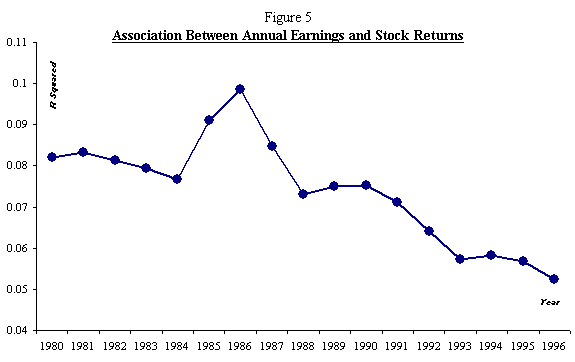
What about other information items?
Lev and Zarowin (1999), Brown et al. (1999), and Chang (1999) document a
decreasing pattern of association between stock returns and various key financial
variables, such as earnings, cash flows and book (equity) values. And what
about nonaccounting information? Amir et al. (2000) added to the set of
financial (accounting) variables the present value of five-year forecasts of
earnings made by financial analysts. Presumably, analysts are privy to
considerable information beyond the financial reports, and they reflect
this information in their earnings forecasts. Hence, combining the information
in financial reports with that in analysts’ forecasts, and correlating the
combined information with stock returns (reflecting the consequences of
investors’ decisions), will indicate the usefulness of all the information
available to investors (from financial reports and other sources). Estimates by
Amir et al. (2000) clearly indicate that the decreasing pattern of usefulness,
portrayed in Figure 4, holds also for the wide information set, combining
financial and other information. Interestingly, where financial information
fails the most—intangibles-intensive enterprises—the contribution of financial
analysts is the largest. Yet, even with this differential contribution of
analysts, the decreasing trend of usefulness of publicly available information
over the past two decades is unmistakable.
Why the deterioration in the
usefulness of information available to investors? The following surface as
“culprits”: (a) the fast increase in the proportion and importance of
knowledge-based, intangibles-intensive companies in capital markets, and (b)
the deficiency of information concerning the assets and activities of these
companies. Herein lies the main social harm: the current economic environment
is characterized by a fast pace of change and high uncertainty. In such an
environment, relevant and reliable information is a crucial guide to mangers’,
investors’, and policymakers’ decisions. Failure of the major information
system—corporate financial reports—in this economic environment is particularly
damaging.
Since R&D and other intangible
investments are immediately expensed in financial reports, changes in these
expenditures affect the bottom line—earnings—dollar for dollar. The temptation
to change the level of investment in intangibles in order to “manage” reported
earnings is, therefore, large.
Indeed Darrough and Rangan (1999) document that, in the year of initial public
offering (IPO), firms tend to have decreased R&D levels, and consequently
higher reported earnings, apparently in an attempt to improve investors’
perceptions about the company’s prospects. Similar evidence on the use of
R&D to “manage” earnings is also provided by Bushee (1998).
Surprisingly, some companies even
publicly announce the use of R&D as an “earnings booster.” For example, in
a report on Eastman Kodak’s warning to investors of weak sales and earnings, The
Wall Street Journal (September 27, 2000, p. B8) quotes Kodak’s chief
financial officer (CFO) saying that Kodak is considering “belt-tightening
measures, including a cut in digital [cameras] research and development.” The
broader concern, of course, is that some managers may harm the long-term
prospects of their companies to meet short-term earnings targets.
Summarizing, economic theory
attributes seriously harmful private and social consequences to information
asymmetry: decreased social gains from trade, high cost of capital—and the
consequent impediments to corporate growth—and abnormally large gains to
insiders at the expense of outside investors.
Dated accounting and reporting
rules concerning intangibles contribute to information asymmetry. Empirical
evidence indeed indicates that this information asymmetry leads to the
predicted undesirable consequences, namely, systematic mispricing of
securities, high cost of capital, and excessive gains from insider trading.
¨
The distinction between the
accounting treatment of tangible and intangible assets originates from
substantive differences between the two types of assets: the partial
excludability, high uncertainty, and non-tradability attributes of intangibles.
While these attributes may provide some justification for applying specific
accounting measurement rules (e.g., the expensing of employee training
costs), they do not provide any justification for denying investors fundamental
information about intangibles (e.g., the disclosure of employee training costs
in footnotes). Measurement and valuation difficulties concerning intangibles
should not provide an excuse for nondisclosure of relevant information about
intangibles.
¨
The major players in the
information arena—managers, auditors, financial analysts—are generally
comfortable with the current disclosure (rather nondisclosure) environment
concerning intangibles. The immediate expensing of internal and acquired
R&D, for example, is a recipe for boosting future growth of reported
earnings. It also decreases embarrassment and litigation exposure. In such a
“comfortable” arrangement, it will take more than the frequently heard calls
for “voluntary information disclosure” and a “period of experimentation” to
generate a significant change in the information environment.
¨
Hard evidence regarding the
harmful private and social consequences of the disclosure environment of
intangibles (both within business organizations and in capital markets) is fast
accumulating. From excessive cost of capital through manipulation of financial
information, to abnormally high insider gains, the evidence indicates that
significant information asymmetries lead to serious private and social harms.
There is, thus, a scientific base for substantial improvement in information
disclosure concerning intangibles.
The unique
attributes of intangible assets—partial excludability, high uncertainty, and
non-tradability—create serious management, measurement, and reporting
challenges, as discussed in Parts II through IV of this report. How can these
challenges be addressed and overcome? In this concluding section of the report,
I outline my proposal for a coherent and comprehensive information system aimed
at satisfying the needs of both internal (to the firm) and external decision
makers. An effective information system is, of course, a necessary condition
for improved management, investment, and public policy concerning intangible
(knowledge) assets, hence my emphasis here on improving the information
environment.
Current
proposals for improving the information available on knowledge-intensive
enterprises are either silent about the objectives of the proposed information,
or set general and vague targets, such as the improvement of resource
allocation, or the leveling the playing field (between investors and
information-privileged analysts or managers). Such objectives, while desirable,
are too general and nebulous to guide the construction of a complex
information system, aimed at reflecting the value and contribution of elusive
assets, such as intangibles. We need an operational objective for
designing an improved information system.
The
objective of the information system proposed below is the facilitation of one
of the major forces characterizing modern economies: the externalization
and democratization of decision-making processes, both within
organizations and in capital markets. By externalization and democratization I
mean both the ever-growing participation of individuals in capital markets and
the engagement of external entities in the management of businesses.
Obvious to
this fundamental change is the constantly increasing role of individual
investors in capital markets. No longer content with holding indexed funds,
these investors increasingly wish to perform their own investment analysis and
structure built-to-order (BTO) portfolios. Thus, while professional financial
analysts and investment advisors still play a central role in capital markets,
millions of individual investors are becoming their own analysts. True, well
over a thousand financial web sites attempt to cater to the needs of those new
“analysts,” yet these sources mainly provide voluminous data, but very
little relevant information. Particularly missing is information on
intangibles, because these sources basically compile and manipulate publicly
available information (e.g., financial statement data, analysts’ earnings
forecasts, etc.), devoid of meaningful information about intangible or
knowledge assets.
The
democratization and externalization of managerial decision-making processes may
be more subtle, but not less real and fundamental than that of capital markets.
In the industrial-era, vertically integrated corporation, decision-making
authority was largely centralized and confined within the boundaries of the
organization. In contrast, in the modern corporation, an increasing number of
important decisions are shared with entities residing outside the legal
confines of the corporation: customers, alliance partners, suppliers of
outsourced services, etc. Merck is currently a partner in nearly 100 R&D
alliances and joint ventures. Thus, important R&D decisions that were
previously made exclusively and secretly inside Merck are being now made jointly
with a large number of outsiders. Cisco Systems outsources most of its
production and assembly activities, leading to crucial decisions being shared
with outsiders that affect Cisco’s products and delivery to customers. Dell’s
computer configuration decisions (product design) are largely being made by its
customers (the BTO concept), Wal-Mart’s inventory and supply decisions are
mostly made by its suppliers, and the design of open-source software programs
(e.g., Linux) is constantly improved by an informal association of code writers
(with a final decision authority given to a committee). Such externalization of
decision making, of course, fundamentally differs from the decentralization of
decision making, common to the industrial-era corporations, which was confined
within the corporate boundaries.
The
externalization/democratization (a mouthful) process, evolving both in capital
markets and in “the real economy” (business enterprises) creates new
constituencies and enhanced demand for relevant information. Individual
investors now need access to the detailed and nuanced information, which has
thus far been the exclusive domain of financial analysts and investment
advisors. Filling this need is not aimed at satisfying the vague, ethically
laden objective of “leveling the playing field.” The twin aims are rather to
make capital markets more competitive and to enhance the ability of individual
investors to monitor managers’ activities—both important economic objectives of
public policy.
In the
domain of business decision making, the new, external constituencies are the
partners to the networked corporation: alliance members, suppliers and
customers, subcontractors, and public institutions (e.g., universities
cross-licensing patents with business enterprises). These network partners need
relevant and timely information about the corporations they partner with, and
corporations obviously need information about external, network activities,
such as the performance of R&D and marketing alliances.
This,
then, is the major objective of the information system proposed below: to
provide both the needs of the new constituencies, who are emerging from the
process of externalization of business decision making, as well as the enhanced
information need of the corporation concerning its network activities. This
objective of the proposed information system—which is an information
innovation—can also be viewed from the perspective of “disruptive
innovations,” as advanced by Clayton Christensen (1997). Here is the role of
disruptive (to the status quo, but socially desirable) innovation, in
Christensen’s words (2000, pp. 10–11, emphasis mine):
Disruptive innovations typically
enable a larger population of less skilled people to do things
previously performed by specialists in less convenient, centralized
settings. It has been one of the fundamental causal mechanisms through which
our lives have improved. So, take the computer, for example. Remember when you
had to take your punch cards to somebody else in a central office? Then along
comes the PC. It couldn’t do nearly the sophisticated problems that you can
solve on a mainframe—but it brought the masses into the computing business.
And from that disruptive root, it has gotten so good that we can now do in the
convenience of our homes and offices so much more…You can tell the same story
about photocopying—or equity investing…We still need healthcare innovations
that enable individuals to do for themselves what historically nurses had to
provide, that enable nurses to do what you needed a family-practice physicians
to provide, and enable family-practice physicians to do what you needed a
specialist to do…In cases where that’s already happened, we’ve actually
received the Holy Grail of lower cost, higher quality and more convenient
healthcare…Again, it’s those kinds of innovations that enable a larger
population of less skilled people to do things that historically you needed
specialists to do.
In an
increasingly democratized and externalized decision-making environment, an
important role of information should be (paraphrasing Christensen’s last
sentence quoted above) to enable a larger population of investors to do things
that until now only highly qualified financial analysts could do. And to
provide a constantly increasing number of partners to the networked corporation
with sufficient information for optimal decision making. This is the objective
of the proposed information system.
An
analysis of frequently asked questions in conference calls of mangers with
financial analysts (e.g., Tasker, 1998), surveys of voluntary disclosures by
corporations (Financial Accounting Standards Board (FASB), 2000) and polls of decision makers (e.g.,
PricewaterhouseCoopers, 2000) indicate that the information most relevant to
decision makers in the current economic environment concerns the enterprise’s value
chain (“business model” in analysts’ parlance). This is also the
information that the accounting system by and large does not convey in a timely
manner. By value chain, I mean the fundamental economic process of
innovation—vital to the survival and success of business enterprises—which
starts with the discovery of new products/services/processes, proceeds
through the development phase of these discoveries and the establishment of technological
feasibility, and culminates in the commercialization of the new
products and services. This value chain—the lifeline of innovative, successful,
business enterprises—is depicted in Figure 6.
THE VALUE CHAIN SCOREBOARDTM
|
|
Figure 6
DISCOVERY/LEARNING IMPLEMENTATION COMMERCIALIZATION
The value
chain of businesses generally starts (left column in Figure 6) with the
discovery of new ideas for products, services or processes (consider
Cisco’s online product installation and maintenance system as an example of a
business process). Such ideas can emanate from the firm’s internal R&D
process (top box) or from employees’ networks, such as Xerox’s Eureka system—which
shares information and experience among 20,000 technicians—or Bristol Myers
Squibb’s R&D intranet system. Increasingly, knowledge and ideas are
obtained from the outside (middle box, left column), embedded in acquired
assets. In many companies the acquisition of technology and R&D-in-process
now surpasses internal R&D (Cisco Systems, for example).
Knowledge
is also “acquired” by learning from and imitation (reverse engineering) of
others. This process—termed by economists “R&D spillovers”—refers to the
benefits to organizations (or nations) from the innovative activities of others.
Effective and systematic organizational learning requires specific capacity to
learn (“adaptive capacity”), as indicated by a specially designated and staffed
corporate function with qualified personnel, who are actively engaged in
learning (e.g., scientists liaising with universities and research institutes).
The third
major source of new ideas and knowledge, particularly prominent in the modern
corporation, is active and formal networking (bottom box, left panel in Figure
6). Research alliances and joint ventures, and the integration of
suppliers/customers into the firm’s operations (e.g., Dell’s BTO computers)
provide valuable information for the design of new products/services/processes,
and their improvement.
These internal, external, and
networking sources of information and ideas initiate the value chain. They
generally require significant and consistent allocation of resources, while
constituting the most knowledge-intensive phase of the value-chain.
The next phase of the value chain
(middle column in Figure 6) marks the crucial stage of achieving technological
feasibility of the products/services/processes under development. In a
sense, this marks the transformation of ideas into working products. Given the
large variety of products and services developed by business enterprises,
technological feasibility is marked by numerous milestones. In some cases,
patents and trademarks signal a feasible product (although quite often patents
are issued at a very early stage of the development phase). In other cases, the
successful passing of formal feasibility tests, such as clinical test for
drugs, or beta test for software programs, is the mark of feasibility (second
box in the middle column).
Increasingly, Internet and intranet
technologies offer quantitative measures indicating technological feasibility.
Thus, for example, online operations that gained a reasonable number of visitors
(indicated by such frequently used traffic measures as “Reach,” see Demers and
Lev, 2000)—and even more importantly, repeat visitors (indicated by
“loyalty” traffic measures)—clearly exhibit a certain degree of technological
feasibility of network operations. J.C. Penney, for example, recently had 1.3M
unique visitors a month (repeat visitors are counted only once) to its web
site—more than any other retailer of apparel and home furnishings.
This is clearly an indication of a successful web site.
Technological feasibility marks a particularly important phase of the value
chain, bringing with it a substantial reduction in the risk associated
with new products and services (recall the discussion of the risk of
intangibles in Part II). Thus, information on technological feasibility
provides investors and managers important risk gauges.
The final phase of the value chain,
commercialization (right column in Figure 6), signifies the successful
realization of the innovation process. Ideas, transformed into workable
products and services, are in turn brought expeditiously to the market to
generate earnings exceeding the cost of capital. That’s what a business
enterprise is all about.
The proposed information system is
aimed at portraying the enterprise’s success in carrying out the value chain
process. Note that this information is factual; it does not contain
forecasts of future plans and strategies.
Accordingly, managerial concerns with shareholder litigation, which generally
allege reckless or manipulative forward-looking managerial statements, do not
apply here. To
operationalize the information system, we of course need specific metrics.
These will be outlined below, but first a word about the relationship between
the proposed system and accounting.
It is
widely recognized that current accounting systems do not convey relevant and
timely information about the value chain (business model). Investment in
discovery/learning, both internal and acquired, is expensed immediately in
financial reports, by and large, with most expenditures (e.g., on employee
training, software acquisitions, investment in Web-based distribution systems)
not even separately disclosed to investors. The transaction-based
accounting system all but ignores the implementation stage of the value chain
(e.g., a Food and Drug Administration (FDA) drug approval, a patent granted, or
a successful beta test of a software product), although considerable value
creation generally occurs during this stage. And even the commercialization
stage, which generates recordable costs and revenues, is reported in a highly
aggregated manner, defying attempts to evaluate the efficiency of the firm’s
innovation process, such as the assessment of return on R&D or technology
acquisition, the success of collaborative efforts, or the firm’s ability to
expeditiously “bring products to the market.”
These
limitations of accounting-based information are rooted in the structure of
accounting, which essentially reflects legally bounding transactions
with third parties (e.g., sales, purchases, borrowing funds, stock issues). In
the industrial and agricultural economies, most of the value of business
enterprises was created by transactions—the legal transfer of property rights.
In the current, knowledge-based economy, much of the value creation or
destruction precedes, sometime by years, the occurrence of transactions.
The successful development of a drug, for example, creates considerable value,
but actual transactions (sales) may take years to materialize. This is, by the
way, the major reason for the growing disconnect between market values and
financial information.
Viewed
from this perspective, the prosposed information system, which focuses on the
fundamental phases of the value chain, precedes and complements
accounting-based information. Accounting, in a sense, provides a final “reality
check” on the proposed system of value creation/destruction as
products/services/processes move along the value chain.
It should
also be noted that two important aspects of intangible assets, and the modern
corporation in general—scalability through networking and high risk—are all but
ignored by the traditional accounting system, but portrayed in detail by the
proposed system. As Figure 6 demonstrates, the three phases of the value chain
highlighting the scalability efforts of the organization capture both the
investment and outcome of various networking activities (e.g., employee
communities of practice, R&D alliances, customer/supplier integration,
online sales). Concerning risk, the progress of products and services along the
value chain marks a continuous reduction in the associated risk. Furthermore,
the value chain portrays various risk-hedging activities of firms (such as
conducting R&D with partners), along with associated outcomes. The proposed
information system thus complements and substantially expands on the
traditional accounting system.
Figure 6
provides an outline of the value chain (innovation) process of a modern
company. For disclosure purposes, both within the enterprise and to outsiders,
the value chain configuration has to be transformed into a parsimonious set of
measures: a scoreboard. What should be the nature of these measures?
I propose
the following three criteria for the choice of measures comprising the value
chain scoreboard:
1.
All measures are quantitative.
Qualitative aspects of the value chain (e.g., employee work practices, patent
cross-licensing) will be discussed in an annex to the scoreboard.
2.
The measures are standardized
(or easily standardizable), meaning that they can be compared across firms for
valuation and benchmarking purposes. Nonstandardized measures, such as employee
satisfaction indicators, are of limited usefulness.
3.
Most important, research has
shown that the measures are relevant to users, generally by establishing a
significant statistical association between the measures and indicators of
value (e.g., stock return, productivity improvement).
There are 10 fundamental links in
the value chain scoreboard (boxes in Figure 6). I will consider each of these
10 links, outlining the specific measures proposed for disclosure. Note: the
large number of measures mentioned below is due to the large variety of
business enterprises. For a given organization, typically no more than 10–12
indicators will suffice.
1.
Internal renewal.
Voluminous evidence (surveyed in
Part III) indicates that, on average, investment in R&D, IT, and customers
pays off in terms of increased productivity and capital market values of
companies. Therefore, I propose the disclosure of periodic R&D
expenditures, meaningfully classified; for example, R&D aimed
at new products, improvement, or maintenance of existing products, and cost
containment R&D (process R&D). Expenditures on the internal development
of information technology should also be disclosed and classified meaningfully.
Data relating to customer acquisition costs (particularly relevant for Internet
companies) should be disclosed, and these should be reported separately from
advertising and marketing expenses. Expenditures for employee training enable
the assessment of companies’ human resource practices, and should therefore
prove useful to decision makers. These are the major components of the internal
investment in renewal.
2.
Acquired knowledge.
Data disclosing the acquisition of
technology and R&D-in-process, as well as information supporting IT
acquisition—classified to software and hardware—are useful to decision makers.
If the company has a formal “adaptive capacity” function, aimed at the
systematic learning from others, data on the periodic expenditures on this
function will also augment decision-making capabilities.
3.
Networking.
This category of the discovery
phase of the value chain calls for information on the number of R&D
alliances the company is engaged in, the total investment in such alliances,
and the investment in the integration of customer/supplier systems (e.g.,
involvement in business-to-business (B2B) exchanges). In the qualitative annex
to the disclosure system, information elucidating the stage of alliance
development (initial stage, product development stage, or dormant) will prove
useful. For Internet enterprises, the presence/absence of alliances with “top
players” (e.g., AOL, Yahoo!) reveals much.
The above-mentioned measures, which
portray the discovery/learning phase of the value chain, are essentially
factual cost data, easily available to all corporations. It is often
stated that, when it comes to intangibles, cost (investment) data are
irrelevant because “cost is unrelated to value.” This statement is both
empirically wrong an informationally irrelevant. The extensive survey of
empirical evidence provided in Part III of this report makes it abundantly
clear that the cost of intangibles is, on average, highly correlated
with (closely related to) value. On average, the more the enterprise spends on
R&D, IT, or customer acquisition; the higher the value added in terms of
productivity, earnings, and market values.
The statement about the irrelevance
intangibles’ of cost data also ignores the importance of such data for any
return on investment analysis. The original price one has paid for a stock may
not be the best indicator of its current or future value, but it is an
indispensable component of the return-on-investment calculation. Cost (investment)
data of intangible capital are, therefore, an essential piece of the value
chain puzzle. Information on various aspects of the value of intangibles
provides the missing pieces. Such value-related information is outlined thus.
4.
Intellectual property.
This first link in the
implementation phase (middle column in Figure 6) refers to data on intangibles
secured by legal rights. The number of patents, trademarks, and
copyrights registered during the period, as well as patent renewals, provide
the rudimentary information. Empirical research (e.g., Deng et al., 1999; Hall
et al., 2000) indicates that various attributes of patents, such as the number
of citations to the firm’s patent portfolio contained in subsequent
patents (“forward citations”), are important indicators of the quality of the
firm’s science and technology. A variety of information pertaining to patent
attributes may be obtained from specialized vendors. The qualitative annex can
include a brief discussion of the firm’s efforts to appropriate the benefits of
its legal property, such as the state of litigation of patent infringement.
Of particular importance are data
on royalties received from the licensing of patents and know-how. Gu and
Lev (2000) report that investors place higher value on such royalties than on
most other components of income, probably due to the long-term nature of
license agreements. Furthermore, royalties assist investors in valuing the
prospects of R&D expenditures of companies. The R&D expenditures of
firms with substantial royalty income are accorded higher market valuations
than R&D of companies lacking royalties, probably because the existence of
customers for the firm’s patents attests to the superior value of its R&D.
Surprisingly, some companies known to have significant royalty income (e.g.,
IBM, Texas Instruments) do not disclose this information. Thus, data on the
intellectual properties of companies (legally protected intangibles) provide
the first intimation of the value of intangibles.
5.
Technological
feasibility.
This marks a crucial stage in the
value chain and an important indicator of risk reduction (Part II). Resulting
information from clinical and feasibility tests (e.g., beta test for software),
can be most effectively communicated in a qualitative manner. For on line
(Internet) operations, the state of technological feasibility can be
communicated by “traffic (eyeball) measures,” such as unique visitors to the
site, or “Reach” (percentage of unique visitors of total web users). Such
measures—collected by specialized companies (e.g., Nielsen/Netrating, Media
Metrix)—can be used for benchmarking and were shown (e.g., Demers and Lev,
2000) to be statistically associated with market values. The company can
provide this information to investors at substantially lower cost, compared
with its purchase by individual investors.
6.
Customers.
Relevant customer information
includes the number of marketing alliances and investment therein. For Internet
companies, quantitative information on customers’ “stickiness”—that is the
extent of web usage (e.g., time spent, on average, in the firm’s site, number
of pages read, etc.)—as well as information on customer “loyalty” (e.g., repeat
buyers), provide important indicators of the quality of the customer base. The
size of the customer base (e.g., number of E*trade subscribers) completes the
proposed customer-related section.
7.
Employees.
This is arguably the most neglected
disclosure area. This is surprising, because in the current, tight labor
markets, policies aimed at securing qualified employees and retaining them are
of the utmost importance. Accordingly, information on workplace practices
(e.g., incentive-based compensation, training) should be provided in the
qualitative annex, along with quantitative information illuminating employee
retention rates and the structure of the work force. The latter can be
conveyed, for example, in the form of the ratio of scientific/technical
employees (e.g., scientists, IT personnel, etc.) to total employees—hot
skills-to-total workforce.
The data in links 4–7 thus provide
information on the intermediate, implementation stage of the value chain. I
turn now to the final stage: commercialization.
8.
Top line.
Information in this link is aimed
at highlighting the impact of the firm’s innovation activities on the top line:
revenues of the enterprise. Revenue growth (by product/service segments) and
market share data are essential top line information items. Of particular
relevance is an indication of the firm’s ability to quickly “bring products to
the market.” This may be conveyed by the measure of “innovation revenues,”
indicating the percentage of revenues coming from recently introduced products
(e.g., those introduced during the last 3–5 years). For example, the stated
policy of the highly successful medical-device company Medtronic (total market
value $63B in September 2000) is to have “70% of revenue coming from products
launched in the previous two years.”
The 3M Corporation was among the first to include innovation revenue data in
its financial reports.
Finally, highlighting the growing
importance of Internet activities, data that documents the share of revenues
coming from online activities will prove useful. Similarly for information on
the share of revenues generated from networking activities (alliances and joint
ventures). Of particular importance are data on customer online purchases
(complementing the traffic data discussed above). For example, in the 1999
Christmas season, a J.C. Penney’s customer spent, on average, $151 in online
purchases, second only to Ebay successful take of $152 per customer.
9.
The all-important
bottom line.
The accounting system provides the
fundamental information on earnings and cash flows. Additional relevant
bottom-line information includes data on productivity gains from R&D
activities and the cash “burn rate” (number of quarters of operations that can
be supported by available liquid resources) for start-ups. Given the popularity
of various measures of “value added,” namely earnings minus a charge for the
cost of equity capital, it seems reasonable to report these measures.
10. Growth options.
Economic theory postulates that the
value of a business enterprise equals the value of “assets in place” (i.e., the
firm’s assets minus liabilities) plus the present value of growth options. The
latter is the present value of future “abnormal earnings,” namely the part of
earnings that exceed the cost of equity capital. For most modern enterprises,
the component of value derived from the growth options far exceeds that related
to “assets in place,” which are mostly physical and financial assets, as
evidenced by the market-to-book ratio (Figure 1, Part I). Accordingly,
information on growth options—hard data rather than “dreams”—is an important
part of the value chain scoreboard.
Growth option information includes
data supporting products in the pipeline and expected launch dates
(routinely disclosed, for example, by pharmaceutical and car companies; see
FASB, 2000), information on expected cost savings from restructuring activities,
planned major capital expenditures (provided, for example by chemical
companies; FASB, 2000), and expected growth of markets in which the firm
operates, and its expected shares in those markets (provided according to FASB
(2000) by chemical companies). For pharmaceutical companies, information
detailing “off-patent products” (the expiration dates of patents for major
products) is of considerable importance for assessing growth option.
At first
blush, the large number of measures outlined above may seem overwhelming and,
therefore, impracticable. This is not so. The list is large because it covers
the relevant information of a wide variety of enterprises. A typical
company will have a parsimonious set of 10–12 key value chain indicators. For
example, I expect a biotech company to report the following value chain
scoreboard:
Discovery/Learning
1.
Investment in internal and
acquired R&D, classified by types of R&D.
2.
Investment in alliances/joint
venture; total number of such alliances; active and dormant ventures (including
data on the investments of alliance partners).
3.
Investment in information
technology.
Implementation
4.
Number of new patents, and
attributes of (e.g., citations to) the company’s patent portfolio. Trademarks
and copyrights, if any.
5.
Cross-licensing of patents
and royalty income from patent licensing.
6.
Results of clinical tests and
FDA approvals.
7.
Employee retention data and
workforce structure (e.g., ratio of scientists and R&D personnel to total
employees).
Commercialization
8.
Innovation revenues
(percentage of revenue from recent products).
9.
Revenues from alliances/joint
ventures.
10. Cash burn rate.
11. Product pipeline; expected launch dates of new products;
products off patents.
12. Market potential for major new products.
This is obviously a parsimonious
list of indicators, providing an important complement to currently disclosed
data.
The proposed value chain scoreboard
is aimed at informing both managers and investors—at different levels of detail
and frequency, of course—about the company’s innovation activities. Corporate
decision makers will presumably secure value chain information as needs arise.
But how will investors obtain such information? What will motivate managers to
publicly disclose this information in a systematic and consistent manner?
Some
believe that it is a matter of time until managers realize that a need exists
for extensive, intangibles-related information, and that they will then provide
the information. In the meantime, it is argued, “a period of experimentation”
with new information modes should be encouraged. Defying this approach is that
it flies in the face of reality: if after 10–15 years of unprecedented growth
in the value and economic impact of intangibles the FASB (2000, p. 5) still
concludes that there is “lack of meaningful and useful disclosures about
intangible assets,” one must ask whether this “experimentation process” is
working, and how long might it last?
The second
approach at eliciting information from managers centers around the creation of
the “right incentives for information disclosure.” By right incentives the
advocates of this approach generally mean the strengthening of safe-harbor
rules shielding managers from shareholder litigation. There are two major
problems with this approach. First, there are already reasonably strong
safe-harbor rules for forward-looking managerial disclosures. Any considerable
strengthening of these rules will come close to completely immunizing managers
from shareholder litigation. Is this in the public’s interest? Moreover,
economic theory (“optimal signaling”) postulates that, for a message to be
credible and effective, there must be a considerable penalty for
misinformation. Clearly, the more effective the safe-harbor rules, the less
credible the disclosed information will be. The second problem with the
proposal to enhance safe-harbor rules in order to motivate the disclosure of
intangibles-related information is that most of this information is historically
based (factual), rather than forward looking. For example, of the 10 links
in the proposed value chain scoreboard (Figure 6), the first nine deal with
factual information. Safe-harbor rules are largely immaterial for such
information.
Accounting
policymakers such as the FASB, the Securities and Exchange Commission (SEC),
and the American Institute of Certified Public Accountants (AICPA) (and
corresponding bodies in other countries) have dual roles: they prescribe
(mandate) information structures (e.g., a cash flow statement) and individual
items (e.g., employee stock option information) that have to be
disclosed in financial reports, and they attempt to establish standards—a common
language of disclosure. The former, regulatory role of policymakers is
widely known and often contested by corporate managers. The latter,
standardization role is much less appreciated. An example of the
standardization role of accounting policymaking is the FASB’s “conceptual
framework,” which consists of six extensive statements outlining the nature and
measurement of financial information items, such as assets, liabilities,
revenues, and expenses; as well as the fundamental postulates underlying
accounting principles, such as relevance, reliability and materiality.
Notably,
there is no regulation (required disclosure) in the “conceptual framework,”
rather an attempt to create a uniform standard of measurement and disclosure.
The discussion of “assets,” for example, outlines the characteristics required
from an asset to be recognized in financial reports (e.g., future economic
benefits, the enterprise has control over these benefits, etc.), as well as
valuation criteria for assets (e.g., write-off in case of impairment).
Such standardization creates a useful language; it enables users of financial
reports to understand the meaning of the numbers presented in financial
statements (e.g., that asset values on the balance sheet refer to historical
costs, and not current values), and to compare the information across
companies. Such standardization through common-language creation is, I believe,
required to elicit wide disclosure of intangibles-related information to
investors.
I propose
that an appropriate accounting policymaking body, preferably the FASB with
strong encouragement and oversight by the SEC, will take upon itself the major
task of standardizing intangibles-related information. By standardization, I
mean the following: (a) creating a coherent structure of information,
and (b) defining the individual information items composing the
information structure. By information structure, I mean a comprehensive set of
interrelated reports, such as the current balance sheet/income statement/cash
flow statement nexus that constitutes the backbone of conventional financial
statements, or the value chain scoreboard outlined in this report. The
individual information items that make up the intangibles report—such as
expenditures on customer acquisition, Internet traffic measures, or innovation
revenues—will require careful definition (e.g., what goes into customer
acquisition costs), and valuation criteria must be clearly specified (e.g.,
should customer acquisition costs be amortized—and how?).
This is
obviously not the place to delve into the details of the proposed
standard-setting task; but, given the extent and pervasiveness of intangibles,
it is obviously a major endeavor. However, the extensive experience of
accounting policymakers in setting standards for financial information will
come handy.
I strongly
believe that if a coherent, well-defined and information-relevant system will
be developed to reflect major attributes of intangible assets and their role
(along with other assets) in the overall value creation process (business
model) of the enterprise, most managers will respond by disclosing the proposed
information. The reason for my optimism is that the availability of a new
disclosure structure, endorsed by the major accounting policymaking
institutions—and perhaps by other influential bodies (e.g., the big-five
accounting firms)—will initiate the “information revelation process” discussed
in Part IV. Enterprises with “good news” (e.g., high innovation revenues,
successful alliances) will start disclosing, in effect “forcing” others to join
ranks. No news is bad new in capital markets—silence is penalized.
¨
The key to achieving
substantial improvement in the disclosure of information about intangibles is
to construct a comprehensive and coherent information structure that focuses on
the big picture—the value creation (innovation) process of the enterprise—and
places intangible assets in their proper role within this structure. This will
clarify to managers what is rather obscure now, i.e., what is useful
information about intangibles.
¨
While focusing on what
information yields functionality through disclosure, it is equally important to
clarify what does not. In particular, managers should not be expected to
disclose values of intangibles, despite the frequent calls for such
information by commentators. Determination of asset and enterprise value is
better left to outsiders (e.g., financial analysts).
¨
Short of enacting new
disclosure regulation, for which there is no current appetite, the way to induce
the release of meaningful information about intangibles is for policymakers to
establish an information standard. Standards have previously worked
wonders in eliciting production and widespread participation. A standard
scoreboard, such as the one outlined above, portraying the innovation process
of businesses and focusing on the intangible investments generating this
process, will drive a large number of companies to provide new and useful
information, internally and externally.